How many sessions of Dual Yellow laser are needed to reduce acne redness? There's no single, definitive answer because Dual Yellow Plus+, the dual-wavelength laser used at Fresh Code Clinic to treat lingering acne redness, doesn't specify a fixed number of sessions. The number of sessions and downtime depend on the severity of the redness, skin condition, and post-treatment care. The clinic itself doesn't specify the exact number of sessions. This article explains what acne redness is, what the device helps with according to the clinic's claims and supported by available evidence, as well as information on treating melasma, dark spots, and skin brightening, the number of sessions required, downtime, and post-treatment care. This is general knowledge and not a diagnosis.
Key Takeaways
- Post-acne redness (PIE) is the redness that remains after inflammation. Unlike post-acne hyperpigmentation (PIH), which is caused by pigmentation, it's important to differentiate between the types of marks before choosing a treatment method.[2][3]
- According to the clinic, Dual Yellow Plus+ emits two wavelengths of light: yellow light at 578 nm for redness and blood vessels, and green light at 511 nm for pigmentation issues. However, the clinic's own service page concludes that there is no research found directly on this type of device for post-acne redness.[1]
- There is no fixed number of sessions for everyone. The clinic's service page does not specify the number of sessions or the intervals between them. Results and recovery time depend on the severity of the marks, the occurrence of new acne, skin sensitivity, and post-treatment care.[1]
- The claim that this type of laser treats melasma and brightens the skin is not supported by evidence. A study at Siriraj Hospital in Thai women found that this type of laser was ineffective against melasma, and there was no research measuring skin brightening results. After treatment, sunscreen should be used, and pimples should not be picked or squeezed.[1][7]
This table compares what the clinic states with verifiable evidence found on the clinic's service page. Details are in the section below.
| subject | The clinic stated. | Examinable evidence |
|---|---|---|
| Redness after acne | Used to treat lingering redness after acne has subsided.[1][5] | No direct treatment of copper bromide laser was found for post-acne redness.[1] There were 40 other people who underwent a single session using a 577 nm laser; there was no control group.[8] |
| Inflammatory acne | Helps reduce redness and inflammation of acne (Acne Clear Dual Program).[5] | The U.S. FDA specifies 578 nm for acne treatment, but there is no direct research on this device.[1] |
| Capillaries on the face | 578 nm light is used for abnormal blood vessels.[1] | A small study in Türkiye in a group of 12 people who used copper bromide showed some improvement, but 6 out of 12 developed post-treatment hyperpigmentation, which resolved spontaneously within 3–4 months.[1] |
| Post-inflammatory hyperpigmentation; superficial dark spots. | 511 nm light is used for pigmentation problems, including post-inflammatory hyperpigmentation.[1] | No research was found, and it is not on the list of findings provided by the U.S. FDA.[1] |
| translucent | The service page does not specify that it is used to treat melasma. | In a Siriraj study of Thai women with skin types III–V, after 6 treatments, the measured pigment values did not improve. The author concluded that the treatments were ineffective.[1][7] |
| freckles, dark spots | 511 nm light is used for freckles and dark spots.[1] | The FDA defines lentigines (sun spots) at 511 nm, but no clinical studies found that deemed this size appropriate, and no data was available for ephelide-based freckles.[1] |
| Bright, even-toned skin | Brightens and evens out skin tone.[5] | No studies were found that measured skin brightening with this type of laser.[1][5] |
| Number of times | The service page does not specify the number of times or the interval.[1] | There is no single numerical answer; a doctor must assess each individual case.[1][2] |
Why do acne redness marks take a long time to heal, and how is Dual Yellow Plus+ involved?
Many people experience reduced acne inflammation, but are left with red marks, especially on the cheeks, chin, and jawline. Some have to cover them with concealer daily because the marks are still visible. This residue is called post-acne redness. A literature review describes it as persistent redness and dilated capillaries that remain after acne has healed or been treated. Some fade on their own, but lingering marks can be quite concerning.[2]
Red marks are not the same as dark marks. Red marks are residual marks left after inflammation, while dark marks result from changes in pigmentation after inflammation. In lighter skin tones, the remaining marks are usually red marks, while in darker skin tones, they are more often dark marks. Many people have a mixture of red marks, dark marks, and true scars. Red marks and dark marks usually fade over time, while true scars remain.[3] Therefore, it's important to first observe what type of mark is bothering you, as each type requires a different approach.
Recurring or persistent red marks are often associated with recurring acne breakouts in the same spot. For an overview of recurring acne and other types of acne scars, please read our article. Acne scars and recurring acne. This article focuses specifically on redness and the lasers used at the clinic to treat it directly.
What is Dual Yellow Plus+ laser?
Dual Yellow Plus+ is a laser that uses copper and bromide as energy sources, thus emitting two wavelengths of light in a single device. As stated on the clinic's website, this machine is manufactured by Norseld, Australia.[1]
Regarding authorization, the clinic states that the device has Thai FDA approval, but the service representative says they cannot verify the registration number and should request it from the clinic. Furthermore, the US FDA's 510(k) database shows clearances for the Norseld Dual Yellow D10B model from 2003 and 2004, which indicate authorization for sale and use in the US but do not guarantee effectiveness for all problems mentioned in this article. The service representative also has not yet verified the documentation for the actual model used at the clinic.[1]
| wavelength | According to the clinic, it is used for... | What the service page detected. |
|---|---|---|
| 578 nm (yellow light) | Red blood pigment in blood vessels, abnormal blood vessels, red scars, red birthmarks, and redness after acne. | The U.S. FDA has classified copper bromide for non-malignant vascular lesions, inflammatory acne, wrinkles, and scars, but there is no direct testing of copper bromide on post-acne redness.[1] |
| 511 nm (green light) | Melanin pigmentation; pigmentation problems such as freckles, dark scars, and post-inflammatory hyperpigmentation. | The U.S. FDA lists benign pigmentary lesions, such as lentigines, but melasma and post-inflammatory hyperpigmentation are not on the list of detected conditions.[1] |
The principle behind having two wavelengths is that the doctor can select the light that matches the color of the mark, instead of using the same setting for the entire face. This is a concept of the device, not a proven result that shows it's more effective than using a single wavelength, as no direct comparative studies were found in the service provider's website or this article.[1]
At Fresh Code Clinic, this laser is part of the Acne Exit and Acne Clear Dual programs. Acne Code Treatment Program To treat both acne and any remaining scars.[5] This information pertains to the equipment and programs used in clinics. Regarding research, a review of 18 studies on post-acne redness found that some lasers and topical medications appeared effective, but there was no single "gold standard" method, and no serious side effects were observed in the compiled studies. This overview pertains to lasers used for redness, not to the results of any single device specifically.[2]
What are the benefits of Dual Yellow Plus+?
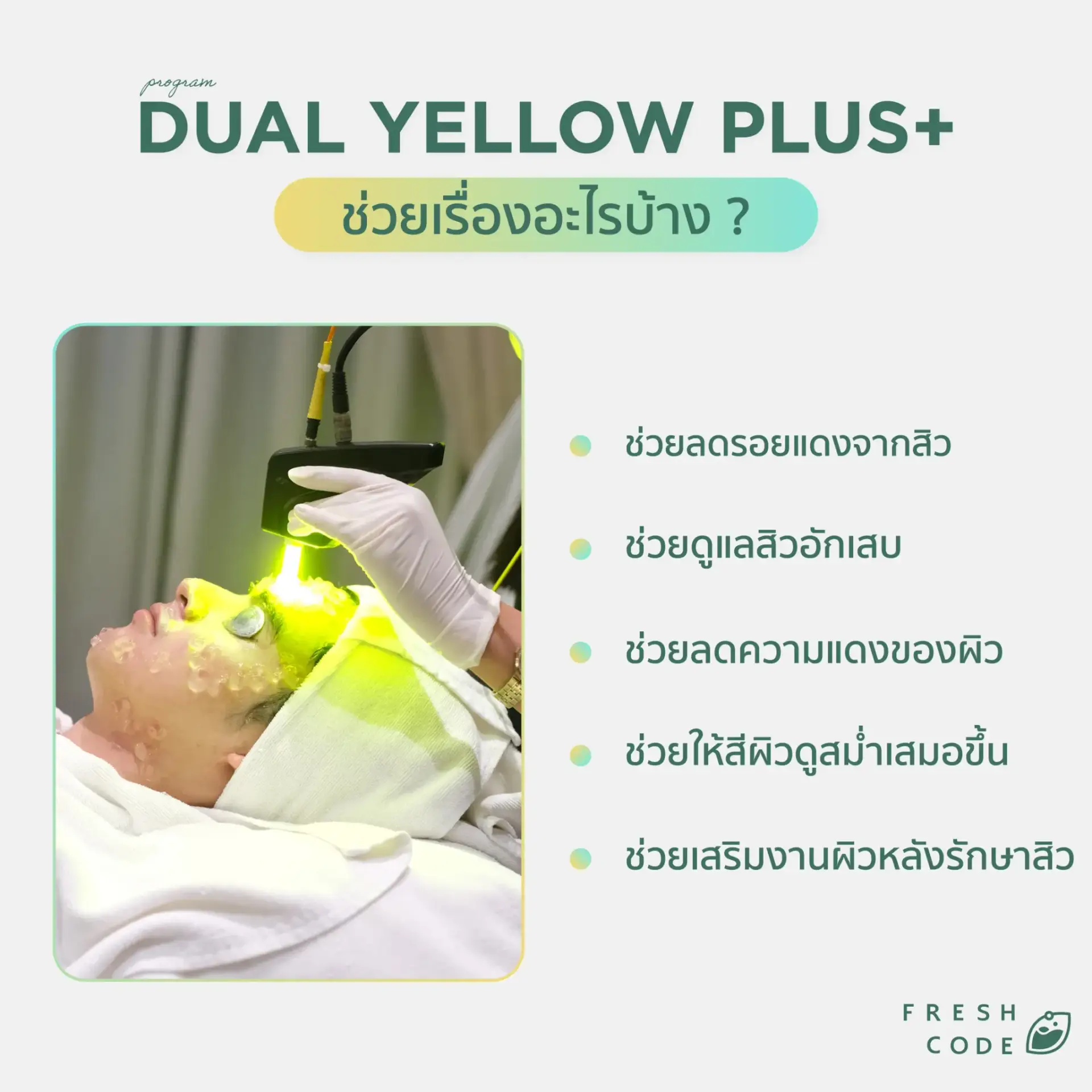
As stated on the clinic's services and programs page, this device is used to handle the following, with verifiable evidence of its use.[1][5]
- Reducing redness from acne and managing lingering redness after acne subsides is its primary use. While there is no direct evidence of copper bromide's effectiveness on post-acne redness, studies using other 577 nm lasers have shown improvement in redness to a significant percentage of 40 participants after a single treatment, without a control group.[8]
- For treating inflammatory acne, the clinic states that it helps reduce redness and inflammation of remaining acne with the Acne Clear Dual program. However, the evidence is that the US FDA specifies 578 nm for inflammatory acne, but there is no direct evidence of the device's effectiveness.[1][5]
- Reduces skin redness caused by broken capillaries. 578 nm light is used on vascular lesions as clinically indicated. A small study in Turkey where the clinic claims to have shown some improvement in facial capillaries, but post-treatment hyperpigmentation was observed in 6 out of 12 people in the copper bromide group, which resolved spontaneously within 3–4 months.[1]
- It makes skin tone appear more even. The clinic states it helps brighten skin tone, but there is no research measuring brightening or skin tone evenness with this type of laser. If redness fades, overall skin tone may appear more even, but this is not the same as whitening the skin.[1][5]
- Enhances post-acne skin care. Use in conjunction with acne extraction and skin recovery programs as specified by the clinic.[5]
This device is primarily used for treating redness. If the main problem is dark spots, pigmentation, or acne scars, other methods may be needed in conjunction, as assessed by your doctor, such as: Discovery Pico The clinic states that it treats pigmentation and skin texture. The front-line service at Discovery Pico concludes that the most evident results are with acne scars, and that the effects are significantly different from those on melasma.[9] See the article for details. Is Discovery Pico laser for skin brightening good?
What should you understand first if you want brighter skin (face skin brightening treatment)?
The term "face skin brightening treatment" is very broad and can refer to more even-toned skin, more hydrated skin, or brighter skin, which are not the same thing. The primary goal of Dual Yellow Plus+ is to reduce redness. If the skin appears dull due to lingering redness, reducing redness may lead to a more even skin tone. However, the clinic's service representative has not conducted clinical trials regarding the brightening effects of this device.[1]
For other services at the clinic that use similar terminology, you should check the evidence for each individual service, such as the service page. Fresh Beam It indicates that no studies were found that measured skin whitening.[13] And the service page of... C-Acne Clear It states that there is no evidence of skin whitening or brightening from the first use.[14] Before making a decision, tell your doctor what you mean by "brightening," such as reducing redness, reducing dark spots, or moisturizing the skin, as each goal requires a different approach.
How many Dual Yellow laser sessions are needed to see results? How many sessions are needed to reduce acne redness?
The short answer is there's no single, definitive number of times for everyone. A review of post-acne redness indicates there's no gold standard method and more randomized studies are needed.[2] The clinic's service page itself doesn't specify the number of visits or the intervals between visits.[1] Therefore, doctors must assess each person's skin condition before making a plan.
The research findings don't directly answer the question of how many treatments of Dual Yellow Laser are needed to see results. Other 577 nm lasers require a single treatment and post-treatment evaluation; this isn't the case with Dual Yellow, and there's no control group.[8] The Siriraj study on Dual Yellow for melasma involved 6 treatments spaced 2 weeks apart. This is a research model for melasma and is not the recommended number of treatments for acne redness.[7]
Factors that cause the number of times to vary from person to person.
- The intensity and duration of redness vary; recurring or long-lasting marks tend to take longer to appear than newly formed marks.
- New breakouts of inflamed acne can make acne scars less noticeable because the new scars replace the old ones.
- Skin that is sensitive or easily irritated may need to have the energy and pace adjusted to suit its needs.
- If dark spots or uneven skin texture are present, an overall assessment of the skin is necessary, not just focusing on redness alone.
- Post-treatment care, picking at pimples, sun exposure, or using irritating skincare products can affect the speed of results.
It's also important to remember that some post-acne redness fades on its own over time.[3] Your doctor will assess whether your marks are long-standing and warrant laser treatment, or if you're still in the stage where you can observe the results. You should also ask about the recommended number of sessions and when follow-up assessments will be held.
How long is the recovery period after Dual Yellow Plus+ treatment, and how should I care for my skin afterward?
The clinic's service page does not specify the downtime. The side effects reported on the page are minor and temporary, including redness, burning, peeling, hyperpigmentation, and scabbing. In the capillary treatment group, hyperpigmentation was observed after treatment in about half of the copper bromide group, but it resolved on its own.[1] The service page summarizes that the data obtained does not support the claim of being gentle on all skin types. Therefore, post-treatment symptoms will vary from person to person, depending on their original skin condition, skin sensitivity, and the energy level used. People with sensitive skin or active acne may need more time to rest their skin and avoid triggers. If you have an important appointment, please inform your doctor in advance.
Post-treatment care focuses on gentle techniques, eliminating the need for multiple additional skincare steps.
- Apply sunscreen regularly. Post-inflammatory hyperpigmentation is a common result of laser treatment, especially on darker skin tones, and studies following picosecond laser treatment (not Dual Yellow) indicate that sunscreen is often used to reduce the likelihood of hyperpigmentation.[6]
- Do not pick or squeeze pimples yourself, as this causes further inflammation and new scarring.
- Avoid using multiple strong skincare products at once, because if your skin becomes irritated, you won't know which product is causing it.
- Hydrate your skin with a gentle moisturizer to help restore your skin barrier.
- Stop using unnecessary active ingredients if your skin becomes irritated, and follow your doctor's or clinic team's instructions.
Repeated sun exposure or excessive use of acids and alcohol may slow down the fading of scars. If you experience unusual pain, increased swelling and redness, or if blisters and pus form, contact your doctor immediately. Before treatment, inform your doctor if you have a tan or have recently been exposed to strong sunlight, have a history of post-inflammatory hyperpigmentation, have skin infections or severe acne, are pregnant, or are taking any medication.[1]
Who is Dual Yellow Plus+ suitable for?
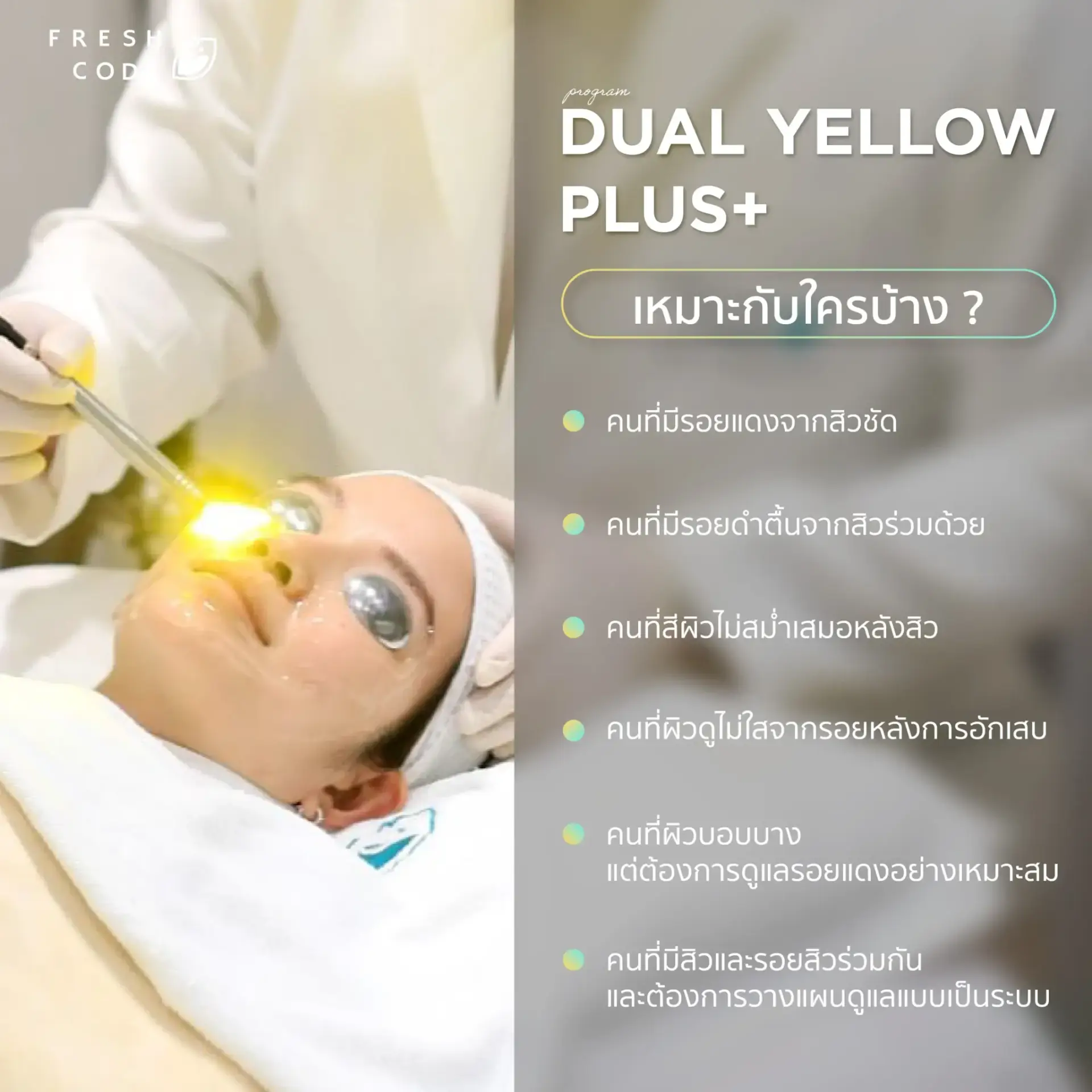
According to the clinic, this device is suitable for the following groups of people, but a doctor will need to assess each individual's skin condition first.[1][5]
- People who have noticeable redness from acne, especially after the acne has cleared up but their skin is still not clear.
- People with superficial hyperpigmentation should have their condition assessed by a doctor to determine which type of hyperpigmentation is suitable, as the clinic states that 511 nm light is effective against pigmentation issues. However, there is no research yet on its effect on post-inflammatory hyperpigmentation, so a doctor should evaluate the specific type of hyperpigmentation to determine the most suitable treatment.[1]
- People with uneven skin tone after acne, as indicated by the Acne Clear Dual program.[5]
- This product is for people whose skin appears dull due to redness after inflammation. The goal is to reduce redness, not to whiten the skin.
- People with sensitive skin who need proper care for redness should have a doctor assess them first.
- For people who want to systematically treat both acne and acne scars.
People with sensitive or easily irritated skin should always have a doctor evaluate them first, as the energy levels and treatment plan need to be adjusted according to their skin condition. For those who want to treat acne as well, the clinic's programs that include Dual Yellow Plus+ are as follows:[5] The clinic's program page does not specify the machine model, number of sessions, and spacing of each component. This should be inquired about before starting. Furthermore, no research testing the entire program was found.
| Program | Includes (as specified by the clinic): | The clinic stated that it is suitable for... |
|---|---|---|
| Acne Exit | Unlimited acne extraction and injection as appropriate (please inquire about conditions), Dual Yellow Plus+, Vitacool. | Multiple types of acne simultaneously, acne in various locations, accompanied by redness or dark spots, and a need for skin recovery after treatment. |
| Acne Clear Dual | Algy Peel Off Mask (Acne Formula), OMG LED Light Therapy, Dual Yellow Plus+ | Acne accompanied by noticeable redness, uneven skin texture, or uneven skin tone, especially after the acne has subsided but the marks remain. |
The clinic's Acne Clear and Acne Clear Plus programs are suitable for early-stage acne or recurring inflammatory acne. A doctor will assess which program is best for you; don't choose based solely on the program name.[5]
FAQ (Frequently Asked Questions)
Q: Can Dual Yellow Plus+ help reduce redness from acne?
Q: How many Dual Yellow laser sessions are needed to see results?
Q: Do I need to rest my face for several days after Dual Yellow Plus+ treatment?
Q: Is Dual Yellow Plus+ suitable for sensitive skin or those with active acne?
Q: Can Dual Yellow Plus+ treat melasma, dark spots, or brighten the skin (face skin brightening treatment)?
Q: What questions should I ask the clinic before undergoing Dual Yellow Plus+ treatment?
Conclusion
Dual Yellow Plus+ is a laser used at the clinic to treat post-acne redness. The number of sessions and the time it takes to see results vary depending on the severity of the redness, the occurrence of new acne, skin condition, and post-treatment care. Evidence of this device's effectiveness on post-acne redness is limited, and it is not supported for treating melasma or achieving skin whitening, as stated by the clinic. A doctor will assess each individual's skin before selecting a treatment program.[5] Therefore, it's best to consult a doctor first to determine whether the main problem is redness, dark spots, or persistent acne, before choosing the appropriate course of action.
For those searching for "dermatologist Bangkok Sukhumvit" or "dermatology doctor in Sukhumvit area," please check the medical license number and specialist status with the Medical Council of Thailand (tmc.or.th).[10] And ask the doctor directly if they are a certified specialist, which the American Academy of Dermatology also recommends asking.[11] Fresh Code Clinic, located at 19 Sukhumvit Soi 5, near BTS Nana, Exit 1, has parking available. It's open daily from 11:00 AM to 8:00 PM. Call 02-253-2236 or 083-626-4264. One doctor's profile states they are a dermatologist and laser specialist, but doesn't list their dermatology qualifications. Therefore, it's advisable to inquire directly about the doctor's qualifications.[12] Please check the latest flight times before traveling. The information in this article is general knowledge and is not a diagnosis or guarantee of results. For more information, consult a doctor for evaluation.
References
- Dual Yellow Plus+ — Fresh Code Clinic service page (includes a summary of evidence and research examined on that page).
- Post-acne erythema treatment: A systematic review of the literature — J Cosmet Dermatol, 2022
- Easy as PIE (Postinflammatory Erythema) — J Clin Aesthet Dermatol, 2013
- Treating melasma: Copper bromide laser effectively targets vasculature — Dermatology Times, 2008 (News summary; only the beginning section is available).
- Acne Code: Acne Treatment Program including pimple extraction and laser treatment — Fresh Code Clinic
- A Randomized, Double Blinded, Split-Face Study of the Efficacy of Using a Broad Spectrum Sunscreen with Anti-Inflammatory Agent to Reduce Post Inflammatory Hyperpigmentation After Picosecond Laser — Clin Cosmet Investig Dermatol, 2022
- Therapeutic outcome of melasma treatment by dual-wavelength (511 and 578 nm) laser in patients with skin phototypes III-V — Clin Exp Dermatol, 2014 (Siriraj)
- An evaluation of the efficacy of a single-session 577 nm pro-yellow laser treatment in patients with postacne erythema and scarring — Dermatol Ther, 2021
- Discovery Pico laser for brighter skin, reducing dark spots and melasma — Available at Fresh Code Clinic.
- The Medical Council of Thailand
- Best questions to ask when considering a cosmetic treatment — American Academy of Dermatology
- Dr. Chinthip Teerawatthanawit (Dr. Plan) License No. 59916 — Physician Profile, Fresh Code Clinic
- Fresh Beam laser treatment for acne, redness, and enlarged pores — Available at Fresh Code Clinic.
- C-Acne Clear by Plasmalis: Acne treatment with plasma — Fresh Code Clinic service page.