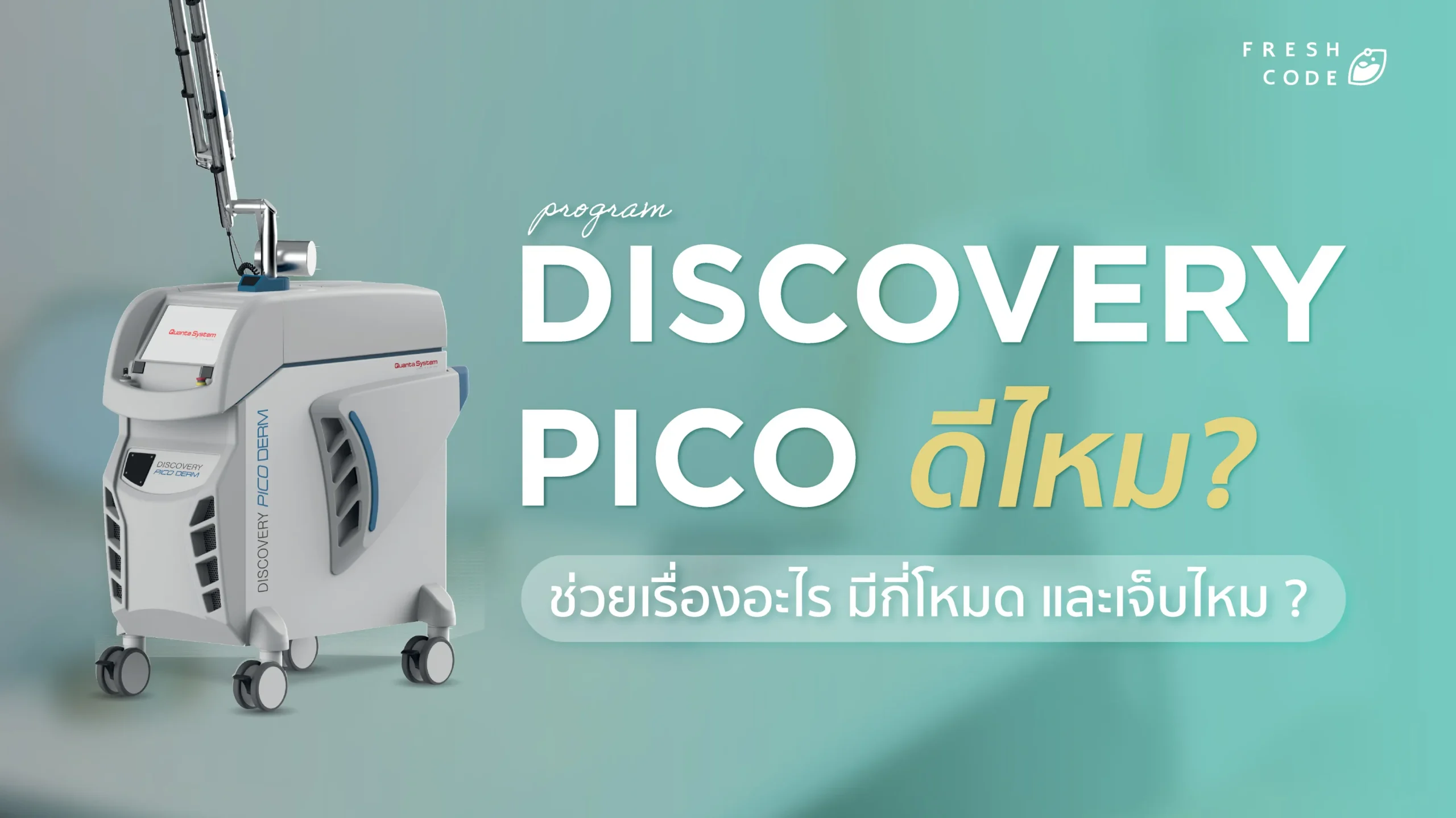
Is Discovery Pico laser for skin brightening good? What does it help with, how many modes does it have, and is it painful?
Lately, I've been getting a lot of questions from patients asking which laser treatment is best for achieving clearer, more even skin tone, or addressing issues like acne scars, melasma, freckles, and other dark spots. One name many people have probably heard of is Discovery Pico, also known as Pico Laser. Frequently asked questions doctors receive include: Is Discovery Pico laser skin brightening effective? How does it help brighten the skin? How many modes does it have? Is it painful? And if I want to treat dark spots or acne scars, which type of laser is best suited for my skin problems? In fact, Pico Laser treatment isn't just about brightening the skin; it can also be tailored to address specific pigmentation issues and skin textures. The doctor will select the technique and energy level best suited to each individual's skin type.
This article will guide you through the process of Discovery Pico, covering its working principles, the skin problems it can treat, the differences between treatment types, the number of sessions required, and preparation and post-treatment skin care, to help you make an informed decision before undergoing treatment.
list of contents
- What is Discovery Pico?
- How does Discovery Pico work on the skin?
- How does Discovery Pico differ from Q-Switched Laser?
- Is the Discovery Pico laser any good?
- What are the benefits of Discovery Pico?
- How many modes does Discovery Pico have?
- Is the Discovery Pico procedure painful?
- How many times do I need to do it to see results?
- Do I need to rest my face after getting Discovery Pico treatment?
- How should I care for my skin after the procedure?
- Who is Discovery Pico right for?
- Why choose Discovery Pico at Fresh Code Clinic?
- FAQ (Frequently Asked Questions)
- summarize
What is Discovery Pico?
Discovery Pico A picosecond laser is a type of laser that emits energy in extremely short bursts, measured in picoseconds, or one trillionth of a second. It uses this laser energy to target pigments and can also be applied to certain types of surface treatments.
The key features of this group of lasers are... This process involves delivering energy in a very short period of time, creating a mechanical effect on the pigment, or a photoacoustic effect. This causes the pigment to break down into smaller particles, which the body then gradually processes through its natural processes. The short energy delivery time also limits heat dissipation to surrounding tissues compared to some types of lasers that use longer energy delivery times. However, this does not mean that Pico Laser is free of heat or side effects, as skin response still depends on the energy setting, type of pigment, and individual skin condition.
at Fresh Code Clinic The Discovery Pico program is used to treat skin problems related to pigmentation, such as acne scars, melasma, freckles, age spots, and uneven skin tone. It also utilizes certain types of lasers to treat uneven skin texture and acne scars as appropriate.
How does Discovery Pico work on the skin?
The working principle of Discovery Pico can be explained in two ways according to its treatment goals:
- Pigmentation Treatment When laser energy is absorbed by the target pigment, it causes changes and breaks down the pigment, allowing the body to gradually process those particles. This approach is applied to certain types of pigmentation problems, such as acne scars, sunspots, and freckles, requiring the selection of the appropriate wavelength and energy based on the characteristics and depth of the pigmentation.
- Skin Texture and Acne Scar Treatment When using a fractional laser head, energy is delivered to the skin in a different way than with conventional pigment treatment, stimulating tissue response and repair processes. This type of treatment may be used to treat certain types of acne scars, uneven skin texture, and visible pores. The results depend on the skin condition and the nature of the underlying problem. Therefore, even though it's the same Discovery Pico procedure, pigment treatment and skin resurfacing aren't all the same. The doctor needs to first assess what the patient's primary problem is.
How does Discovery Pico differ from Q-Switched Laser?
Discovery Pico and Q-Switched Lasers are lasers that can be used to treat pigmentation problems, but they differ significantly in their energy delivery duration. Typical Q-Switched lasers have energy discharge times in the nanosecond range, while Discovery Pico can discharge energy in the picosecond range, which is even shorter. The delivery of energy in a short burst allows for rapid mechanical effect on the pigment and may reduce heat dissipation to surrounding tissues under certain treatment conditions.
however It cannot be concluded that Pico Laser is superior to Q-Switched lasers for all skin problems, as results depend on the type of pigment, wavelength, energy settings, and the selection of the appropriate treatment method.Therefore, the choice of laser treatment should primarily consider the nature of the skin problem, not just the name of the technology.
Is the Discovery Pico laser any good?
If you're asking whether Discovery Pico is good, I'd suggest starting by looking at the root cause of your skin problem. This type of laser can be an option for treating certain types of pigmentation and skin texture issues, but it's not suitable for all skin problems.
For individuals with acne scars, sunspots, age spots, or uneven skin tone due to pigmentation, appropriate laser treatment can help fade some types of marks and improve overall skin tone. However, if the primary problem is inflammatory acne, acne redness, or deep acne scars, laser treatments focused solely on pigmentation may not be sufficient.
For example, Two patients may have similar acne marks on their faces, but one has dark brown marks while the other has red marks from broken capillaries. Although they are collectively called acne marks, the treatment approaches may differ. In some cases, your doctor may consider other programs in combination, such as Dual Yellow for certain types of redness or Venus Viva for surface texture and acne scars, depending on the indications of each program.
Limitations of Pico Laser facial treatment.
It's important for doctors to understand that Pico Laser facial treatment doesn't mean everyone's skin will become whiter or that all types of dark spots will disappear after just one treatment. The results depend on the type of pigment, the depth of the problem, the response to the laser, and accompanying skin care, especially for melasma which has a chance of recurring. For those with dull skin due to dehydration, inflammation, or irritation, restoring the skin and addressing the underlying factors may be more important than starting laser treatment immediately. Therefore, before making a decision, you should have a doctor assess whether the problem you see is due to pigmentation, redness, or skin texture, in order to plan treatment that addresses the actual cause.
What are the benefits of Discovery Pico?
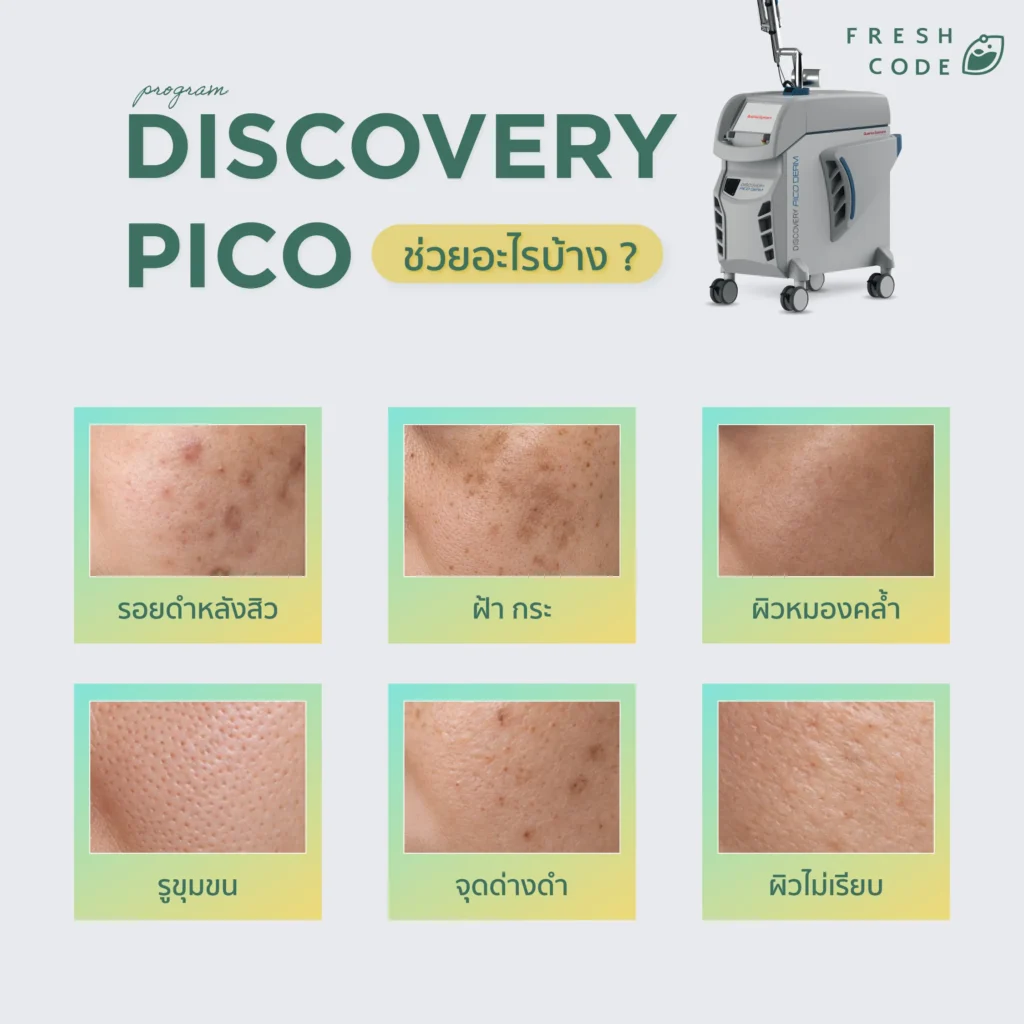
The Discovery Pico laser can be used to treat a variety of skin problems, each with different goals and treatment approaches. The most common groups treated include:
- dark spots after acne Acne scars are caused by an inflammatory process that stimulates melanin production. This means that after the acne clears, brown or dark spots remain on the cheeks, chin, or jawline. Discovery Pico may be an option for treating certain types of hyperpigmentation. A doctor will assess the appearance, intensity, and condition of the scar before selecting the appropriate energy level. However, if inflammatory acne persists, the acne problem should be treated concurrently to reduce the formation of new dark spots in the future.
- Freckles, blemishes, and dark spots Discovery Pico can be used to treat certain types of pigmentation, such as freckles, sunspots, and age spots, depending on the individual's type and depth of the pigment. For melasma, a more detailed evaluation is required because melasma is related to multiple factors, including sun exposure, hormones, and the response of melanin-producing cells. Laser treatment in some individuals with melasma may cause irritation or stimulate the melasma to darken. Therefore, laser treatment should not be used alone without addressing the underlying triggers. In general, the treatment of melasma should prioritize sun protection and appropriate dermatological treatments first. Laser treatment is an optional treatment that a doctor may consider in some cases.
- Dull skin, uneven skin tone For individuals with dull skin due to pigmentation or scattered dark spots on the face, Pico Toning may help to gradually brighten the overall complexion and even out skin tone. However, if the cause of dull skin is insufficient sleep, dry skin, or inflammation, laser treatment may not be able to completely resolve those issues. Therefore, a doctor should assess the overall skin health to choose the most appropriate treatment method based on the root cause of the problem.
- Pores and uneven skin texture Some forms of picosecond laser treatment can be used to treat uneven skin texture and visible pores, particularly using a fractional head to stimulate the skin's restructuring process. The results may improve the appearance of skin texture in some cases, but it doesn't mean pores will disappear or become permanently smaller. If you also have oily skin, clogged pores, or loss of skin elasticity, your doctor may need to consider treating those issues in conjunction with the treatment.
- Acne scars and some types of scars. Acne scars result from changes in skin structure after inflammation, varying in appearance and depth, such as shallow scars, well-defined scars, and scars with fibrosis. Fractional picosecond laser treatment may stimulate skin restructuring and make some types of scars appear shallower. However, for deep scars or those with significant fibrosis, other treatments may be necessary, such as scar tissue cutting or other surface resurfacing procedures. Therefore, pico laser treatment is one option for treating certain types of acne scars; it is not a method that can resolve all types of scars.
How many modes does Discovery Pico have?
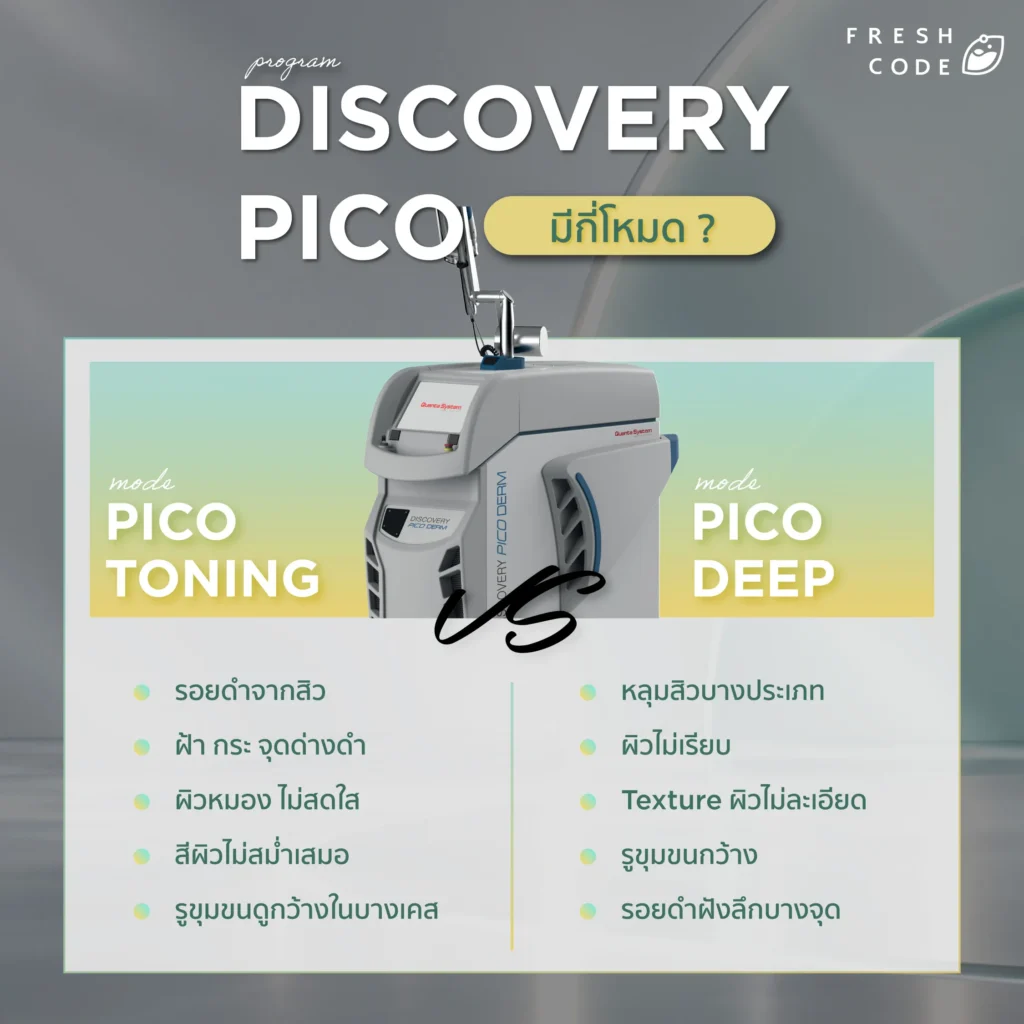
How many modes does Discovery Pico have? This is a question many patients wonder about, because when researching information from different clinics, they may find different program names such as Pico Toning, Pico Deep, or Pico Bright. It's important to understand that the program name used by clinics to communicate with patients may not be the technical mode name directly defined by the device manufacturer. The Discovery Pico family of devices allows for flexible adjustment of energy emission patterns, wavelengths, and laser heads, with specific details depending on the model and the equipment used.
1. Pico Toning
Pico Toning is a laser treatment approach for addressing pigmentation and overall skin tone problems. The doctor will select the appropriate energy level and treatment method for each individual's specific issue. It is commonly used in patients with problems such as:
- Some types of post-acne scars.
- Dark spots and pigmentation that a doctor has assessed as suitable for treatment.
- Uneven skin tone
- Dull skin due to pigmentation problems.
For Pico Laser facial rejuvenation, using this approach, the doctor may choose to treat pigmentation in a large area, but this does not mean that the same energy level should be used across the entire face or that the same method should be applied to every patient. Individuals with melasma or sensitive skin need to consider the risks before choosing a treatment method.
2. Pico Deep
Pico Deep That's the name of the program. Fresh Code Clinic Used to communicate approaches to treating certain types of skin problems, especially those focusing on skin texture and acne scars. This type of treatment may utilize a fractional laser, which delivers energy to the skin in small, targeted pulses to stimulate tissue response and restructuring. Problems that may warrant consideration of treatment in this group include:
- Some types of acne scars
- Uneven skin
- Uneven skin texture
- Visible pores in some individuals.
- Some types of scars.
However, treating deep pigmentation and surface resurfacing with a fractional head are different treatment goals, so it should not be assumed that the Pico Deep program uses the same settings to treat both types of problems.
Pico Bright and Pico Pigmented programs
In addition to the names Pico Toning and Pico Deep, Fresh Code Clinic categorizes its programs by skin problem to help patients easily understand the treatment goals.
- Pico Bright This program is designed for individuals with dull, uneven skin tone who want to improve their overall skin radiance. The doctor will assess whether your pigmentation and skin condition are suitable for laser treatment.
- Pico Pigmented This is the name of a program focused on treating pigmentation problems such as freckles, age spots, acne scars, and certain types of pigmentation that require specific assessment.
For individuals with complex melasma or pigmentation, the choice of treatment program must consider the risk of post-inflammatory hyperpigmentation and the likelihood of recurrence. Furthermore, Pico Heat and Pico Tattoo are specialized treatments with different objectives than general skin brightening lasers. The specific indications for each program should be based on the machine model, laser head, and the physician's assessment.
summarize : Choosing Discovery Pico treatment shouldn't be based solely on the name of the mode, but rather on whether the primary problem is pigmentation, uneven skin texture, or acne scars, and selecting the treatment method that truly best suits that problem.
Is the Discovery Pico procedure painful?
"Is Discovery Pico treatment painful?" is a question many patients worry about, especially those who have never had laser treatment before. The sensation during the procedure may be similar to a light flick of the skin or a warm, pulsating feeling. The intensity of the sensation depends on the treatment method, the energy level, the area being treated, and each individual's pain sensitivity. If Pico Toning is used to treat pigmentation across the entire face, some people may experience less irritation than spot treatment or the use of a fractional head, but this does not mean that everyone will not experience pain. In some cases, a doctor may consider applying a topical local anesthetic before proceeding with the treatment, depending on the patient's needs and suitability.
Steps for creating a Discovery Pico.
For those who have never had Pico Laser treatment before, the general procedure can be divided as follows:
Step 1: Assess the skin problem.
The doctor will examine the appearance of dark spots, melasma, freckles, or other skin problems, and inquire about previous treatments, medication use, and factors that may affect laser treatment.
Step 2: Prepare the skin before treatment.
Clean the area to be treated and consider using a local anesthetic or other skin preparation as appropriate for the procedure.
Step 3: Perform the laser treatment according to the treatment plan.
The doctor will select the appropriate laser head and power setting for the assessed problem, while maintaining standard laser safety eye protection.The treatment time depends on the area being treated and the type of laser used, so it doesn't necessarily have to take the same amount of time in every case.
Step 4: Assess the skin after treatment.
After the procedure, the skin's response will be monitored, and instructions will be given regarding facial cleansing, skincare products, sun protection, and precautions according to the treatment chosen. The actual procedure may vary depending on the skin problem and the doctor's treatment plan.
How many times do I need to do it to see results?
The number of Discovery Pico treatments required depends on the type and severity of the skin problem, the depth of the pigmentation, the treatment method, and the individual's response. For certain types of pigmentation issues, such as some types of dark spots or freckles, changes may be noticeable after treatment, but this does not mean that all marks will fade after the first session.
For acne scars, the number of treatments may depend on the intensity and depth of the pigmentation, as well as the occurrence of new acne breakouts during treatment. In the case of melasma, treatment may require ongoing care combined with sun protection and other dermatological treatments because melasma can recur even after visible changes have been seen after laser treatment.
For those seeking treatment for acne scars or skin texture, changes may occur gradually as part of the skin restructuring process. Therefore, one should not expect all acne scars to become completely flat immediately after treatment.
How long should I leave between each treatment?
The interval between laser treatments depends on the type of skin problem, the energy level used, and the recovery time after the previous treatment. The doctor will assess the skin's response before the next appointment, especially for those with sensitive skin, melasma, or who have undergone fractional treatment, which may require a different recovery period than general pigmentation treatments. More frequent laser treatments don't always mean faster results, and they may increase the risk of irritation if the skin isn't ready for the next treatment.
Do I need to rest my face after getting Discovery Pico treatment?
After Discovery Pico treatment, the recovery time depends on the treatment type and each individual's skin response. With Pico Toning, some cases may only experience slight redness or warmth initially, and patients can return to their daily routine relatively quickly. However, with targeted pigmentation treatment or the use of a fractional laser head, the skin may temporarily experience redness, swelling, or darkening. Some individuals may develop scabs in the treated area. Patients with important appointments, who need to wear makeup daily, or have plans to travel outdoors should inform their doctor in advance so that appropriate laser treatment and recovery time can be planned. In summary, it should not be assumed that all laser modes have the same level of downtime.
How should I care for my skin after the procedure?
After laser treatment, the skin should be cared for gently, especially in the initial period when it may feel red, warm, or sensitive to touch. It is important to minimize irritation, maintain hydration, and provide proper sun protection to avoid factors that may interfere with the skin's recovery process. Primary care guidelines include:
- Avoid strong sunlight and use sun protection methods appropriate for your skin type.
- Apply sunscreen only when your doctor permits and when there are no contraindications to the skin area for product use.
- Choose gentle cleansing and moisturizing products as recommended by your doctor.
- Discontinue use of AHA, BHA, retinoid scrubs and other potentially irritating products for the duration prescribed by your doctor.
- If there are scabs, do not pick or rub the area yourself.
Regarding face washing and makeup application, the actual skin condition after the procedure should be considered. Those without open wounds may be able to return to their daily routine faster than those with scabs or abrasions. If you experience unusually severe pain, increased swelling and redness, blisters, or pus after the procedure, contact a doctor for evaluation. Do not attempt to self-medicate with over-the-counter medications.
Who is Discovery Pico right for?
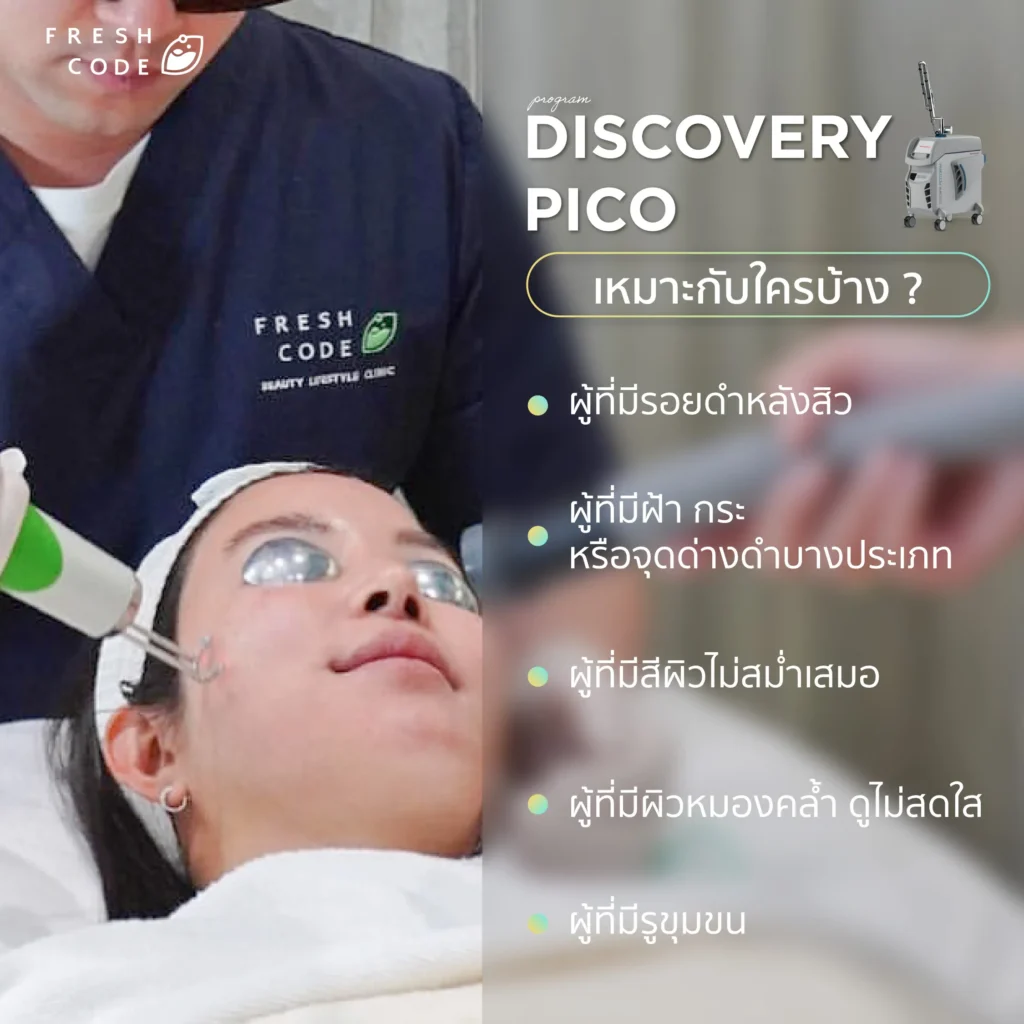
The Discovery Pico program may be an option for people with the following skin problems.
However, people with severe skin inflammation, acne flare-ups, sunburn, or intense skin irritation should always consult a doctor first, as some cases may require acne treatment in combination with other procedures.
- People with dark spots after acne.
- People with certain types of freckles, age spots, or dark spots.
- People with uneven skin tone.
- People with dull, lifeless skin.
- People with enlarged pores
- Those who want to undergo non-surgical laser facial treatment.
However, people with severe skin inflammation, acne flare-ups, sunburn, or intense skin irritation should always consult a doctor first, as some cases may require acne treatment in combination with other procedures.
Who should inform their doctor before undergoing Discovery Pico treatment?
- People with severe acne, open wounds, or sunburn.
- Patients with infections in the treatment area should be evaluated by a doctor first, as in some cases, those problems may need to be addressed before starting laser treatment.
- Patients with a history of post-laser hyperpigmentation, abnormal scarring, facial skin conditions, or those currently taking medications that may affect skin sensitivity should inform their doctor before treatment.
- Pregnant women and breastfeeding mothers
- Patients with underlying medical conditions and those taking ongoing medication should inform their doctor so that the suitability of the procedure can be assessed on a case-by-case basis.
If you have a mole or pigmented lesion that has changed in shape, color, or size abnormally, it should be diagnosed first. Laser treatment for cosmetic purposes should not be used on lesions of unknown type.
Possible side effects after Discovery Pico treatment.
Although picosecond lasers have the characteristic of delivering energy in short bursts, they can still cause side effects, such as:
- Temporary skin redness or swelling.
- I feel a burning or irritating sensation at the treatment site.
- Scabs or blisters may form in some cases.
- Post-inflammatory hyperpigmentation occurs.
- White spots or changes in skin color occur.
- Scarring or infection may occur in some cases.
The risk depends on skin type, energy settings, treatment method, and post-treatment skin care.Before undergoing treatment, you should discuss the expected outcomes, recovery time, and potential side effects with your doctor in order to make an informed decision.
Why choose Discovery Pico at Fresh Code Clinic?
Before undergoing Discovery Pico treatment, the doctor will consider whether the primary skin issue is related to pigmentation, redness, or skin structure, and will also assess whether there is any inflammatory acne or other factors that need prior treatment. If multiple skin problems occur simultaneously, a treatment plan may need to be developed in a specific order. For example, treating inflammatory acne before addressing hyperpigmentation, or separating pigmentation treatment from acne scar treatment as appropriate.
Plan the treatment based on each individual's problems.
The choice between Pico Toning, Pico Deep, or other treatments will depend on the treatment goals and skin condition, not just the program name. In some cases, your doctor may consider other programs if they find that certain types of skin problems are not suitable for treatment with Discovery Pico alone. The goal is to address the problem directly, avoiding unnecessary procedures and considering the potential for irritation or side effects.
For those who are unsure which type of laser treatment to choose, you can consult our medical team. Fresh Code Clinic Assess your skin condition first in order to plan a treatment that is appropriate for each individual's problems.
FAQ (Frequently Asked Questions)
Q: Is Discovery Pico laser for skin brightening good?
It's good if the main problem is dark spots, pigmentation, uneven skin tone, or dull skin, but you should have a doctor evaluate it first. Because if the main problem is redness, acne, or acne scars, other programs may be needed in conjunction.
Q: How many modes does Discovery Pico have?
In practice, there are several approaches to use, such as Pico Toning, Pigment Mode, Fractional Pico, and certain specialized modes, depending on the device model, the type of head used, and the individual's skin problems.
Q: Is the Discovery Pico procedure painful?
Most people feel like a light, warm, pulsating tingling sensation on the skin. Pico Toning usually feels lighter than spot treatment or Fractional Pico.
Q: How many treatments are needed to see results?
Depending on the type of problem, for dull skin or shallow dark spots, you may start to see changes after a period of continuous treatment. However, for melasma, freckles, or deep pigmentation, more treatments may be required.
Q: Do I need to let my face rest after the procedure?
Depending on the mode used, Pico Toning typically requires less downtime than localized pigmentation treatments or Fractional Pico, so it's important to have your doctor explain the post-treatment care plan you've chosen.
Q: Can Discovery Pico help treat acne scars?
It can be used to treat certain types of acne scars, especially with fractional treatment that aims to stimulate the skin's restructuring process. However, for deep acne scars or scar tissue contraction, other treatment methods may need to be considered.
Q: Can Discovery Pico completely cure melasma?
Laser treatment cannot guarantee complete elimination of melasma, as it is a recurring problem. Furthermore, improper laser use may even worsen melasma. Therefore, treatment should be under the evaluation of a physician and include management of triggering factors.
Q: Will my skin become permanently whiter after doing Discovery Pico treatment?
Discovery Pico may help manage certain types of pigmentation and even out skin tone, but it does not permanently lighten your natural skin color. Furthermore, some types of pigmentation problems may reappear when exposed to sunlight or other triggers.
Q: Can Discovery Pico be combined with other procedures?
In some cases, a doctor may consider using Discovery Pico in combination with other treatments depending on the skin problem. However, it is important to assess the suitability and determine the spacing between each procedure to avoid unnecessary irritation or side effects.
Discovery Pico is a picosecond laser that can be used to treat pigmentation problems such as acne scars, freckles, age spots, and certain types of uneven skin tone, as well as some types of rough skin and acne scars when used in appropriate treatment regimens. However, the results and sensation during the procedure depend on the type of skin problem, the treatment method, the energy used, and the individual's response. Therefore, you should not choose a laser treatment based solely on the program's name or the results of others.For individuals with melasma, sensitive skin, acne-prone skin, or multiple skin problems, a pre-treatment assessment is especially important to help plan a treatment that is appropriate for their individual skin condition and risks.
If you would like to know if this program is right for your skin, you can come in and consult with our medical team. Fresh Code Clinic A skin assessment is required first to plan a treatment tailored to each individual's specific problems.
💚Add LINE @freshcodeclinic
📍19 Sukhumvit Soi 5, BTS Nana Exit 1 (Parking available)
📞083-626-4264
🕝Open daily 11:00 AM – 08:00 PM