Is Discovery Pico effective? The answer depends on your primary skin problem. According to the clinic, this is a picosecond laser used to treat pigmentation and skin texture issues, but the evidence is not equally strong. Acne scars have more supporting research than melasma, and "brightening skin" doesn't necessarily mean whiter skin. This article explains the working principle, its benefits, its modes, pain level, required sessions, post-treatment skin care including masks, and things to ask the clinic before deciding. This is general knowledge, not a diagnosis.
Key Takeaways
- Discovery Pico is a picosecond laser. According to the clinic, it's used for treating pigmentation and skin texture. The most proven evidence is its effectiveness on acne scars with the 1064 nm fractional head, but this is a minor procedure with some improvement, not complete elimination.[1][7]
- Melasma: A combined analysis of six randomized controlled trials found significant variations. 1064 nm reduced melasma scores, while 755 nm was no better than creams and caused post-inflammatory hyperpigmentation. Furthermore, 755 nm is not on the FDA clinical indications for melasma treatment.[1][8]
- Pico Bright is the name of a treatment mode and terminology used at the clinic. No research has been found to directly measure skin brightening, and it is not a skin whitening treatment.[1]
- Post-inflammatory hyperpigmentation is a side effect to be aware of. Consistent sun protection is essential, and you should ask the clinic about the device model, FDA registration number, wavelength, and the head used in each mode.[1][6]
Is Discovery Pico any good? What is it, and how does it differ from Q-Switched Laser?

According to the clinic's service page, Discovery Pico is a picosecond-group laser, releasing energy in short pulses of one trillionth of a second.[1] These lasers were initially used for tattoo removal because they aimed for better results with fewer side effects than nanosecond lasers. Later, studies were conducted on their use for pigmentation problems, acne scars, and sun-damaged skin.[2]
The mechanism regarding pigmentation, as described clinically, is that the targeted pigment absorbs the laser energy and breaks down into smaller particles. The body then gradually eliminates these particles on its own.[1] For skin surface and acne scar treatments, the clinic states that they use a fractional laser head that breaks down a beam of light into numerous small dots to penetrate the dermis, stimulating skin repair and new collagen production. However, the service page states that the collagen mechanism is an explanation from the manufacturer and the clinic. Research measuring results in terms of scar score, volume, and skin roughness has not directly proven this mechanism.[1] These two projects have different goals, so they don't use the same methods.
Compared to Q-Switched lasers, which use nanosecond pulses, pico-surgery delivers energy in much shorter bursts. In a split-face study of 14 Asian patients with freckles or Ota's nevus, pico-surgery treatments showed more than half improvement, with picosecond pulses reaching 85.71 TP3T compared to 57.21 TP3T for Q-Switched treatments after approximately 6 months of follow-up, and with less discomfort.[3] However, this was a small study and tested on only certain types of skin blemishes, so it doesn't mean Pico is better for every problem. The clinic's service page itself states that a detailed comparison with Q-Switched systems hasn't been conducted yet, so it can't be concluded that Pico always has fewer side effects or takes less time.[1] The choice should be based on each person's specific skin problems, not on the name of the technology.
Regarding the machine model, the clinic's service page states that if it's the Discovery Pico model from Quanta System (Italy), the US FDA approved this family of machines in 2019 for tattoos, benign pigment lesions, acne scars, and wrinkles. However, the tests did not include melasma, and the approval is from the US, not the Thai FDA. Therefore, you should inquire with the clinic about the actual machine model and registration number they are using.[1]
What are the benefits of Discovery Pico?
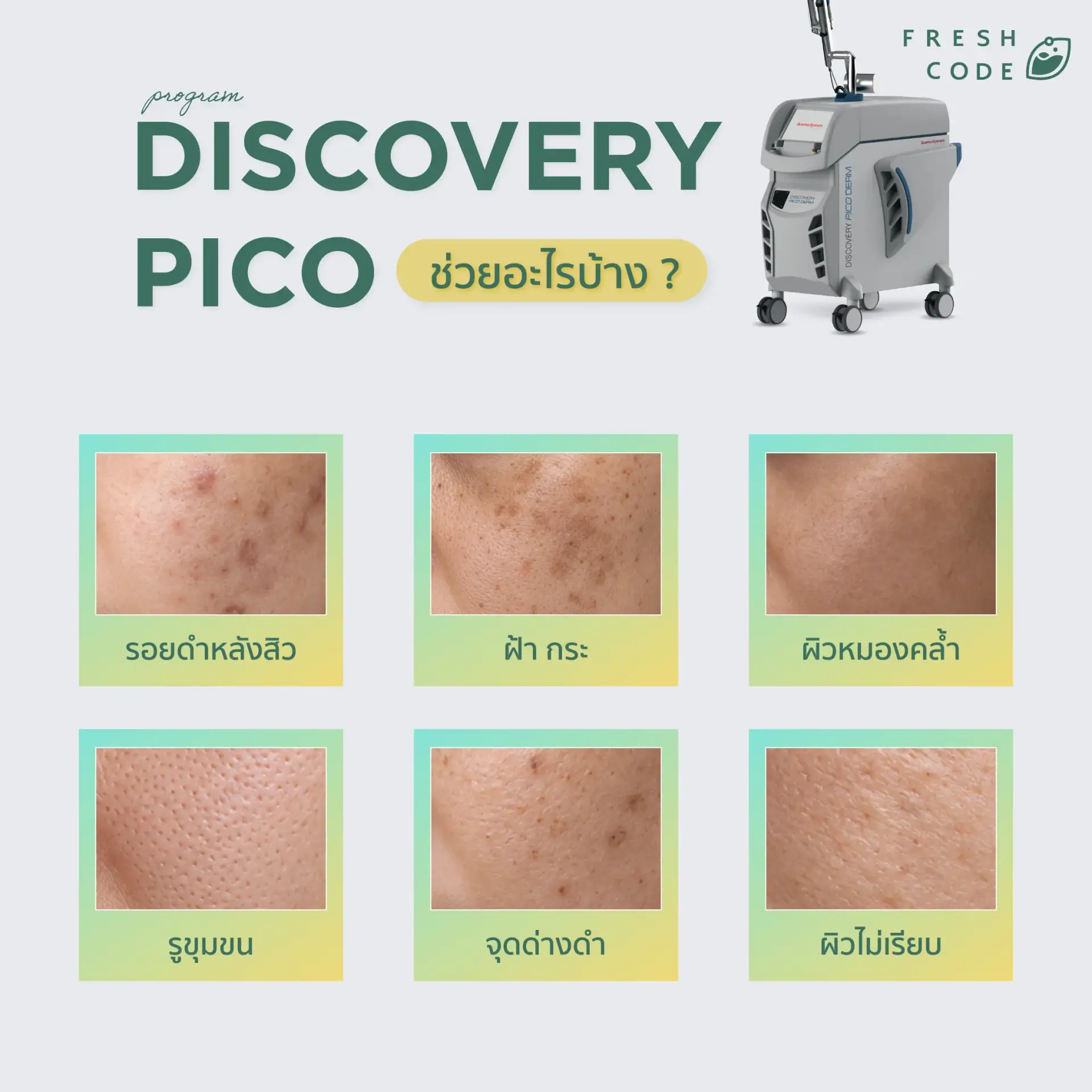
Discovery Pico is used to treat a variety of conditions, but the evidence varies across groups. The table below separates what clinically indicated from what the testable evidence supports. Most of the cited research is small-scale studies and does not specifically mention the Discovery Pico model.
| Skin problems | The clinic stated that: | Evidence and things you should know. |
|---|---|---|
| dark spots after acne | Use Pico Pigmented mode to treat acne scars.[1] | The clinic's service page did not find any research specifically on picosecond mode for this topic, and the FDA listings did not specify post-inflammatory hyperpigmentation for the 532 nm Q-Switched mode.[1] If you still have inflamed acne, you need to control it simultaneously; otherwise, new dark spots will appear. |
| translucent | Use Pico Pigmented mode on frosted surfaces.[1] | A composite analysis of six randomized controlled trials showed significant differences in results. The 1064 nm dose (I² 70%) reduced melasma scores without significant side effects, while the 755 nm dose was no better than depigmenting creams and caused post-inflammatory hyperpigmentation.[8] Melasma is not on the FDA's list of indications for clinical use.[1] Melasma is more complex than freckles and can recur, requiring a particularly detailed assessment.[5] |
| Freckles, dark spots, Ota's nevus | Use Pico Pigmented and Pico Tattoo modes.[1] | The FDA permits benign pigmentary lesions such as lentigines and nevus of Ota, but the service page does not review clinical research for this group.[1] There are small jobs comparable to Q-Switched in the sun and Ota pan.[3] |
| Dull skin and uneven skin tone | Use Pico Bright mode to brighten dull skin and address uneven skin tone.[1] | The service page doesn't display research that directly measures skin brightening. If dull skin is due to dehydration, inflammation, or irritation, the root cause should be addressed first. |
| Pores and uneven skin texture | Use Pico Bright and Pico Deep modes.[1] | In a study conducted at Siriraj Hospital on people with acne scars, skin roughness, measured with a device, decreased at 6 months compared to before the treatment.[7] However, no studies measured pore size compared to a control group, so we shouldn't expect a definitive reduction in pore size. Oily skin and clogged pores require combined management.[1] |
| Some types of acne scars | Use the Fractional Microscope (MLA) head in Pico Deep mode.[1] | A study at Siriraj Hospital involved 26 people and was conducted 6 times, once a month. Six months after the last session, 13 people (50%) showed improvement with at least 50%. There was no control group.[7] A combined analysis of 7 studies (170 people) found that Fractional Picosecond Laser provided results similar to conventional fractional lasers for collapsed acne scars.[4] Deep pits or those with scar tissue contraction may require other methods in combination. |
Radiant and bright skin in Bangkok: A perspective supported by evidence.
Those seeking radiant and bright skin in Bangkok typically desire a brighter and more even complexion. In the case of Discovery Pico, it's important to clarify what the clinic claims and the supporting evidence. The clinic states that the Pico Bright mode is for brightening skin, tightening pores, reducing dark spots, dullness, and uneven skin tone.[1] The most relevant evidence supports this, in the form of reduced skin roughness measured in acne scars and certain benign pigmented lesions listed in the FDA indications.[1][7] The service page does not display research that directly measures skin clarity or brightness.
- Brightening here refers to more even-toned skin as problematic pigmentation is reduced, not to whitening the skin's natural color.
- If your skin is dull due to dehydration, irritation, or acne, laser pigmentation treatment may not be the first step.
- The clinic's Fresh Beam service page states that no skin whitening test results have been found.[11] And the SkinVive service page indicates that the measured increase in hydration was only slight.[12] Therefore, you shouldn't choose a program based solely on the claim of having clear skin.
So, is the Discovery Pico any good? The answer depends on your main problem. This device is best suited when the primary issue is certain types of paint scratches or surface marks, but there are limitations you should be aware of before deciding.
- It doesn't whiten everyone's skin, and it doesn't remove all types of dark spots in one go.
- The results depend on the type and depth of pigment, the skin's response, and other skincare routines.
- Melasma recurs frequently. A review indicates that laser treatment is often a second-line option after systemic topical medications, and evidence for picosecond lasers on melasma is limited and varies depending on the wavelength.[5][8]
- Redness from acne or broken capillaries are not the primary target of the pigmentation mode. The clinic has another type of machine. Dual Yellow Plus+ However, Dual Yellow's service page states that no research has been found regarding post-acne redness, so it's advisable to have a doctor choose the method and explain the evidence first.[10]
How many modes does Discovery Pico have?
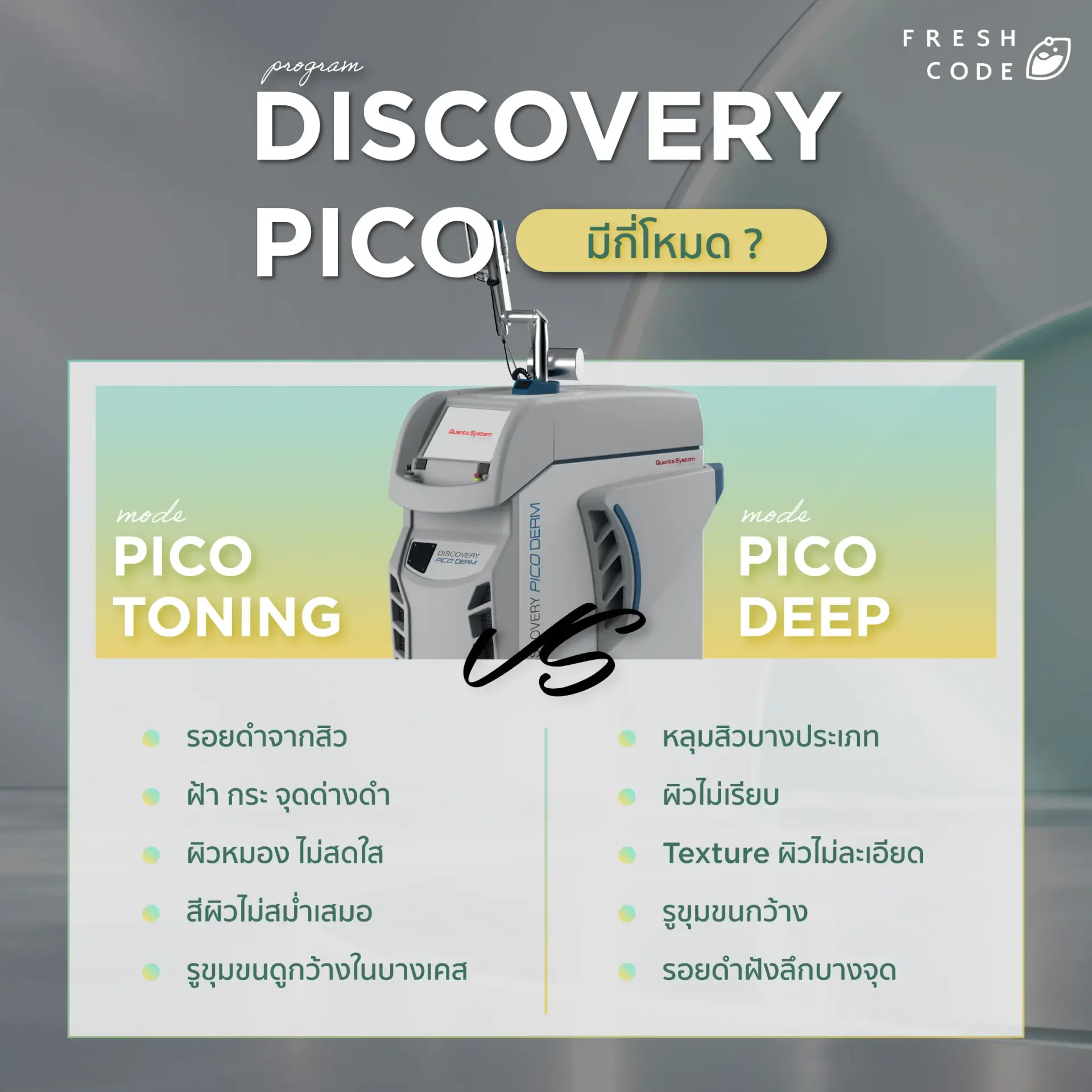
According to the Discovery Pico service page at Fresh Code Clinic, there are 5 modes. These mode names are those used by the clinic for communication and are not listed in the FDA catalog, which categorizes modes by wavelength (532, 694, 1064 nm) and probe type. Therefore, it is advisable to ask the clinic which wavelength and probe type are used for each mode in order to compare it with research and indications.[1]
| mode | The clinic states that it is used for... | Things to know |
|---|---|---|
| Pico Bright | Brightens skin, tightens pores, reduces dark spots, dullness, and uneven skin tone.[1] | This is a clinic description; the service page does not directly display research on this mode. The doctor will first assess whether the pigmentation characteristics and skin condition are suitable for laser treatment. |
| Pico Deep | Acne scars, fine lines, and some types of scars can be treated using a fractional applicator.[1] | The goal is different from pigmentation work, so the same settings should not be used. Research on acne scars is in the previous section. |
| Pico Pigmented | Melasma, freckles, Ota's nevus, dark spots from acne.[1] | Focus on pigmentation that needs to be evaluated specifically. Evidence for melasma and post-acne hyperpigmentation is limited, as per the previous section's table. |
| Pico Heat | Redness from acne, freckles/vascular lesions.[1] | The product page states that the FDA approves this model for mild to moderate vascular lesions and acne in free-running mode, not picosecond mode. It's important to ask which mode the Pico Heat uses. |
| Pico Tattoo | Tattoo removal, Ota's nevus[1] | This is a specialized procedure with different goals than general skin brightening laser treatments. |
You might see "Pico Toning" mentioned elsewhere, but it's not listed as a mode on the clinic's Discovery Pico service page. Therefore, you should ask the clinic if they offer this mode. Importantly, the same mode can feel and produce different results on different skin types, and you shouldn't choose a mode based solely on the name. Consider whether your primary concern is pigmentation, uneven skin texture, or acne scars. For more comparison images, please continue reading the article. Venus Viva vs. Pico Deep
Is Discovery Pico treatment painful? How many sessions are needed, and is there any downtime required?
The sensation depends on the mode, energy level, treatment area, and individual sensitivity. Some clients describe it as a light flicking or a warm, pulsating sensation, but this doesn't mean everyone will feel the same. The clinic's instructions don't specify the pain levels for each mode, so it's advisable to ask the doctor beforehand. In some cases, the doctor may consider applying a local anesthetic. In a comprehensive analysis of acne scars, Fractional Picosecond Laser was found to be less painful and cause less post-inflammatory hyperpigmentation than general fractional lasers, but petechiae (small bleeding) are more common.[4]
General procedure
- Skin assessment: The doctor examines the appearance of dark spots, melasma, freckles, or skin texture, along with a history of treatments, medications used, and other relevant factors.
- Prepare the skin, clean the treatment area, and consider applying a local anesthetic as appropriate.
- During laser treatment, the doctor selects the treatment head and sets the energy level according to the plan. Standard eye protection is provided. The duration depends on the area and type of laser treatment.
- Post-treatment assessment includes checking skin response and providing recommendations on cleansing, moisturizing, sunscreen, and precautions.
How many times do I need to do it to see results?
According to the clinic, minor problems such as freckles, sunspots, dark spots, or dull skin may start to show results after about 1-2 sessions. More complex problems such as deep freckles, enlarged pores, or acne scars may require 5-6 sessions or more. The actual number of sessions depends on each individual's skin condition, which will be assessed by the doctor first.[1] The service page states that there is no research confirming the use of 1-2 treatments for freckles or dark spots. For acne scars, research suggests around 4-6 treatments, spaced about 1 month apart, such as the Siriraj Hospital study which involved 6 treatments, one per month.[1][7] Your doctor should explain the reasons for the recommended number of treatments. There is no fixed number of sessions to space between; your doctor will assess your skin's response before the next appointment. More frequent treatments don't always lead to faster results and may even increase irritation if your skin isn't ready. For melasma, ongoing care is necessary, along with sun protection and other treatments.[5]
Do I need to let my face rest after the procedure?
Depending on the treatment mode and your skin's response, the clinic's service page does not specify the downtime for each mode. Some individuals may only experience slight redness or warmth and return to their daily routine quickly. Fractional pigmentation may cause temporary redness, swelling, darkening, or scabbing. If you have an important appointment or will be outdoors for extended periods, please inform your doctor in advance.
How should I care for my skin after Discovery Pico treatment?
Post-inflammatory hyperpigmentation (PIH) is a common side effect after laser treatment, and it is more frequent and severe in people with darker skin tones because inflammation stimulates the skin to produce more melanin. The main approach is to use sunscreen along with reducing skin inflammation.[6] At Siriraj Hospital, using MLA probes on Fitzpatrick III-IV skin, minor post-inflammatory hyperpigmentation was observed in approximately 181 TP3T treatments, and clinic service reports indicated spontaneous resolution in about 4 weeks.[1][7] Post-treatment care is just as important as the day you visited the clinic.
- Apply sunscreen daily, starting when your doctor permits, and choose a type that's suitable for your skin.[6]
- Cleanse and moisturize gently using non-irritating products, and replenish the skin's moisture barrier.
- Avoid AHA, BHA, Retinoid scrubs and other irritating products for the period prescribed by your doctor.
- Do not pick or scrub at the scabs, as this may cause inflammation and scarring.
- Do not self-medicate. If you experience any skin abnormalities, consult a doctor first.
Contact your doctor immediately if you experience unusually severe pain, increased swelling and redness, or if blisters and pus form. When you can wash your face or apply makeup depends on your skin condition. Those without open wounds can usually resume treatment sooner, but you should follow your doctor's post-treatment instructions.
Pure BIM Hydrating Gel Mask Price, Post-Procedure Mask, and Things to Ask Before Use.
Some people inquire about post-laser treatment masks, including search terms like "pure bim hydrating gel mask price," on the clinic's Pure BIM+ service page. This product is a hydrogel mask (a thin, clear gel sheet) that the clinic states contains brown algae extract and is sterilized using Electron Beam technology. It's used to care for dry, irritated, or sun-damaged skin.[9] The service page recommends asking your doctor when your skin is ready for a mask after a procedure such as laser treatment, and that it should not be placed on open wounds.[9]
The same service page clearly states the limitations: there is no research specifically for Pure BIM+, no complete ingredient list, no information about the original manufacturer, and no FDA registration number. The closest available information is for a different mask formula that is not a hydrogel. Therefore, the clinic does not use the term "treatment" or any high-level comparisons to this product.[9] This article therefore does not claim that the mask helps reduce post-inflammatory hyperpigmentation or speeds up skin recovery after Discovery Pico treatment.
Regarding pricing, this article does not specify prices as prices and packages are subject to change. It is best to inquire directly with the clinic. Before making a decision, you should ask the following questions:[9]
- Full product name (Are Pure BIM, Pure BIM+, and Pure BIM Hydrating Gel Mask the same model? The service page indicates it hasn't been verified), manufacturer, and importer.
- FDA registration number or registration number (if classified as a medical device) and a full list of ingredients, including the types of seaweed used.
- When to use it after the procedure, for how many minutes, and how many times?
- Is this included in any procedure package, or is it charged separately?
- Inform your doctor if you have ever had an allergic reaction to cosmetics, seaweed extracts, or seafood, and stop using the product immediately if you experience severe burning, a rash, or swelling.
Who is Discovery Pico right for?
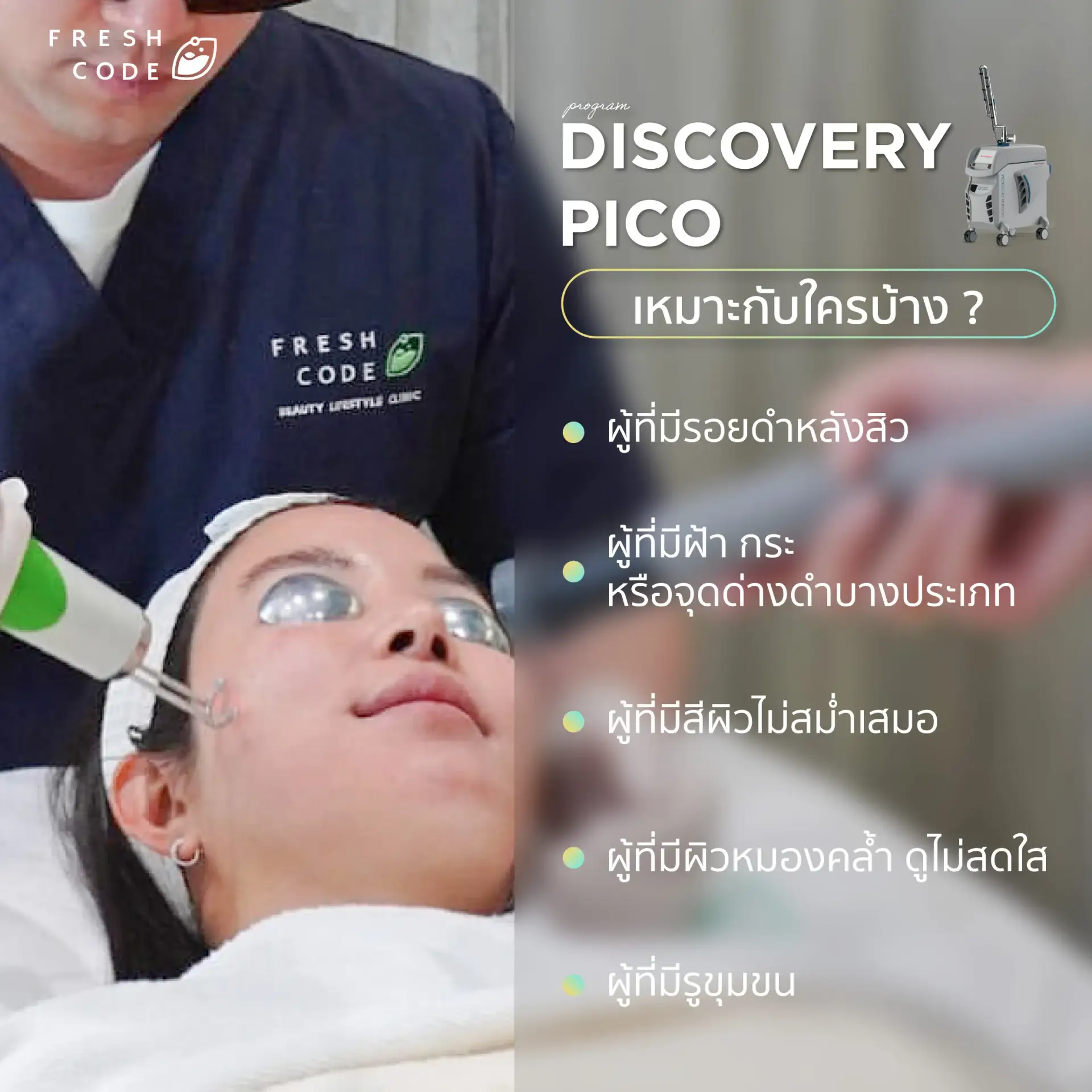
According to the clinic, this treatment is suitable for individuals with the following problems who wish to have non-surgical skin care. A doctor will assess the area and determine the appropriate treatment method.[1]
- dark spots after acne
- Certain types of freckles, melasma, or dark spots.
- Uneven skin tone or dull complexion.
- Visible pores or uneven skin texture.
- Some types of acne scars
If you have severe acne, a breakout, sunburn, or significant irritation, you should always consult a doctor for evaluation, as your skin may need to be soothed before laser treatment.
Who should inform their doctor before undergoing this procedure?
- Severe acne, open wounds, sunburn, tanned skin, or recent sun exposure.
- There is an infection in the area to be treated.
- Have you ever experienced post-acne or laser scarring? Do you have unusual scarring? Do you have any facial skin conditions? Or are you using medications that may affect your skin sensitivity?
- Pregnant or breastfeeding.
- I have underlying medical conditions and am taking medication continuously.
- Moles or pigmented lesions that have changed in shape, color, or size should be diagnosed first. Laser treatment for cosmetic purposes should not be used on lesions of unknown type.
The actual contraindications depend on the device manual and the physician's assessment.[1]
Possible side effects
A review of picosecond research shows that most studies report positive results and infrequent side effects.[2] However, it can still be found in some individuals, as follows:
- Temporary skin redness or swelling.
- Burning or irritation
- Scabs or blisters may form in some cases.
- Post-inflammatory hyperpigmentation[6][7]
- White spots or changes in skin color.
- Scarring or infection, which is rare.
Things to ask the clinic before starting.
The clinic's service page recommends asking the following questions before starting:[1]
- Model number, FDA registration number, and registered indications for use in Thailand.
- Wavelengths and heads used in each mode.
- Recommended number of times and intervals for addressing personal problems, along with the reasons.
- The chances of post-inflammatory hyperpigmentation and how to care for your skin and use sun protection after treatment.
The risks depend on skin condition, energy level, treatment method, and post-treatment care, which the doctor will explain before starting each procedure. The before-and-after photos from the clinic in the review section are examples of real case results. Results vary from person to person and are not a guarantee.
FAQ (Frequently Asked Questions)
Q: Is Discovery Pico any good?
Q: How many modes does Discovery Pico have?
Q: Is Discovery Pico treatment painful, and how many sessions are needed to see results?
Q: Will Discovery Pico treatment completely remove melasma or just whiten the skin?
Q: How effective is Discovery Pico in achieving radiant and bright skin in Bangkok?
Q: How much does Pure Bim Hydrating Gel Mask cost, and what questions should I ask before using it?
Conclusion
Is Discovery Pico good? It depends on your main problem. There's small-scale evidence supporting its effectiveness for some types of acne scars and pigmented lesions. However, evidence for melasma, post-acne hyperpigmentation, and skin brightening is limited or there isn't yet direct measurable research. At Fresh Code Clinic, according to our services, doctors treat each case individually, assessing whether the problem is pigmentation, redness, or skin structure. They also check for inflammatory acne or other factors that need addressing first, then select the appropriate mode for your treatment.[1] Before starting, you should ask about the machine model, FDA registration number, wavelength and head used, as well as information about the post-procedure mask, such as: Pure BIM+ This article does not specify the price.
For those searching for a dermatologist in Bangkok's Sukhumvit area, convenient location is often a preferred choice. This article does not guarantee that all doctors at Fresh Code Clinic are specialist dermatologists. The profiles on the clinic's website vary, for example: Doctor Plan's profile The clinic stated that the doctor was a dermatologist and laser specialist.[13] You should check the license number and specialty of the doctor you will be seeing with the Medical Council of Thailand (tmc.or.th).[14][15] Before making a decision, Fresh Code Clinic in Sukhumvit Soi 5, near BTS Nana, Exit 1, has parking available and is open daily from 11:00 AM to 8:00 PM. Call 02-253-2236 or 083-626-4264. Please check the latest hours before visiting. The information in this article is general knowledge and is not a diagnosis or guarantee of results. For more information, consult a doctor for evaluation.
References
- Discovery Pico laser for brighter skin, reducing dark spots and melasma — Fresh Code Clinic
- Evolution of the Picosecond Laser: A Review of Literature
- Picosecond Laser More Effective Than Q-Switched for Pigmented Lesions
- Fractional Picosecond Laser is an Effective Treatment For Atrophic Acne Scars — Dermatology Times
- Melasma: When is laser treatment considered? — Dermatology Times
- A Randomized, Double Blinded, Split-Face Study of the Efficacy of Using a Broad Spectrum Sunscreen with Anti-Inflammatory Agent to Reduce Post Inflammatory Hyperpigmentation After Picosecond Laser
- Manuskiatti W, et al. Objective and Long-Term Evaluation of the Efficacy and Safety of a 1064-nm Picosecond Laser With Fractionated Microlens Array for the Treatment of Atrophic Acne Scar in Asians — Lasers Surg Med, 2021 (Siriraj Hospital, 26 people, no control group)
- Feng J, et al. Efficacy and safety of picosecond laser for the treatment of melasma: a systematic review and meta-analysis — Lasers Med Sci, 2023
- Pure BIM+ Hydrogel Mask — Fresh Code Clinic
- Dual Yellow Plus+ — Fresh Code Clinic
- Fresh Beam — Fresh Code Clinic
- SkinVive — Fresh Code Clinic
- Dr. Chinathip Theerawattanawit (Dr. Plan), license ว.59916 — Fresh Code Clinic
- The Medical Council of Thailand — Check the list of doctors.
- Experts advise checking the credentials of practitioners before seeking cosmetic services to prevent unlicensed doctors from impersonating them (Published October 2021) — Thai PBS