Acne scars and recurring acne are different problems. Acne is inflammation, while acne scars are the resulting marks. Therefore, it's necessary to differentiate between scar types and control acne simultaneously. This article explains the types of acne scars, the causes of recurring acne, the four steps of the Spotless Skin program at Fresh Code Clinic, and how to prepare and care for your skin after treatment. This is general knowledge and not a diagnosis.
Key Takeaways
- Acne scars (PIE), acne pits (PIH), and acne scars are caused by different mechanisms, so it's necessary to categorize them before choosing a treatment method. Some types of scars may also persist if left untreated.
- Recurring acne in the same spot is caused by many factors, not just hygiene. Inflamed acne should be controlled first; otherwise, new scars will replace the old ones.
- Fresh Code Clinic's Spotless Skin treatment consists of four steps: clearing acne, treating dark spots with Discovery Pico, treating redness with Dual Yellow Plus+, and revitalizing the skin with Vitacool.
- Using sunscreen with an SPF of 30 or higher every day, and avoiding picking or squeezing pimples, will help prevent acne scars from becoming darker. However, deep acne pits need to be assessed separately by a doctor.
Why do pimples keep recurring and leaving acne scars on the skin?
Acne scars are marks left on the skin after acne has subsided or healed. Many people mistakenly believe that acne scars and acne itself are the same thing, but they are actually different problems. Acne is inflammation occurring in the hair follicles, while acne scars are a consequence of this inflammation. This is why many people's skin still looks uneven after their acne has cleared. Furthermore, if acne recurs in the same spot, the scars accumulate, making it difficult to distinguish between old and new marks.
Recurring acne in the same spots isn't caused solely by dirt; a combination of factors is involved, including clogged pores, excess oil, unbalanced skin cell turnover, inflammation, skin bacteria, hormones, and individual habits. Common areas affected include the chin, jawline, cheeks, and forehead. Each episode of inflammation can also leave a different set of scars.
When you examine your own face, you'll find that acne scars don't all come in one form. The table below helps categorize the most common types.
| type | Visible appearance | Main cause | The approach that doctors usually consider. |
|---|---|---|---|
| Red acne marks (PIE) | Red, pink, or purplish-red marks; skin is still smooth, not pitted. | Post-acne inflammation associated with broken capillaries under the skin.[4] | Laser treatments that target blood vessels and inflammation, such as Dual Yellow Plus+, combined with sun protection.[2] |
| Acne scars (PIH) | Brown, gray, or dark spots; the surface remains smooth. | Melanin pigments are produced in increased amounts after inflammation and can darken when exposed to sunlight or picked/squeezed.[4][5] | Use sunscreen daily and undergo laser treatment for pigmentation, such as Discovery Pico, as assessed by your doctor.[1] |
| acne scars | The surface is pitted or uneven, and can be shallow or wide, as well as small and deep. | Tissue and collagen loss from severe acne.[4] | Methods that stimulate collagen production, such as Fractional RF via microneedles, are varied according to intensity.[4] |
The problem is that recurring acne and acne scars often create a cycle. If you don't stop it at one point, the skin will always return to the same condition.
- Do you have clogged pores or inflamed acne?
- Accidentally picking, squeezing, or pressing too hard can deepen the inflammation.
- Redness or dark spots may occur as a result.
- Using harsh products or scrubbing your face too frequently to speed up the healing process can irritate the skin and cause new acne breakouts.
Some types of acne scars fade on their own over time, but scars related to pigmentation, broken capillaries, or acne pits can last much longer. The duration depends on the severity of the original inflammation, skin color, sun exposure, and picking or squeezing the pimples. Waiting for them to heal on their own isn't always the answer, especially if new pimples keep appearing.[4]
What is an acne and acne scar reduction program?
Spotless Skin is a program at Fresh Code Clinic designed for people with multiple types of acne and acne scars simultaneously. The key concept is not to use a single device to solve everything, but to treat each condition separately: addressing existing acne, dark spots, redness, and skin rejuvenation, prioritizing treatments according to each individual's skin type.[3]
Before starting any treatment, the doctor will assess the primary skin problem – whether it's clogged pores or inflammation, whether the marks are red or dark, or both – and how ready the skin is for the procedure. This information will determine which steps to begin with, and it may not be necessary to perform all steps at once.
If you want to see real-world results before making a decision, please see this page. Acne treatment reviews Of the clinic.
A deep dive into 4 steps to repair damaged skin in the Spotless Skin program.
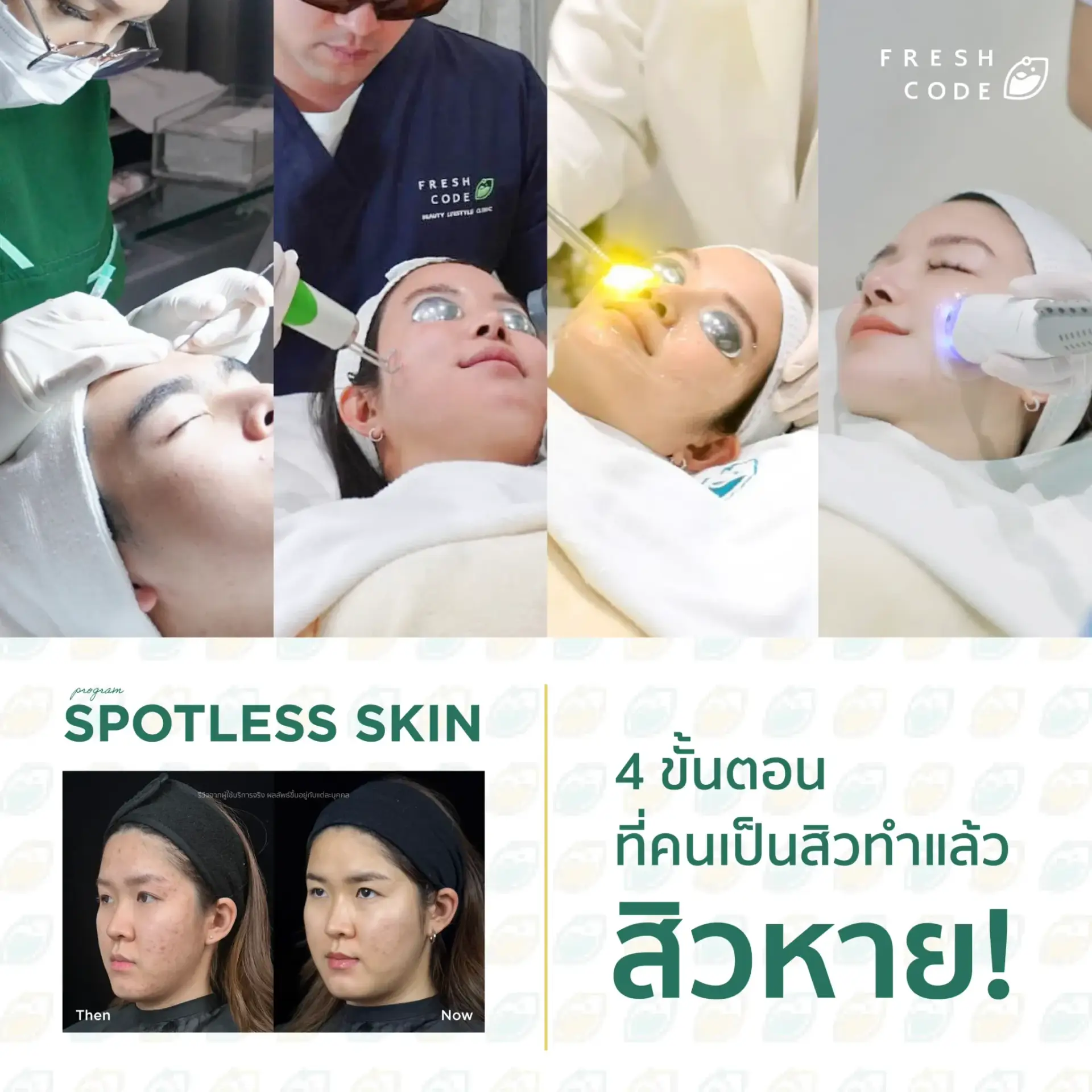
These four steps are not just a list of tools, but are arranged in a logical order based on what the skin should receive first and last.
- Step 1: Clear acne (squeeze and inject pimples). The doctor assesses the remaining acne, including both clogged pores and inflammatory acne, which require different management. The goal is to reduce existing acne and address the underlying causes of recurrence, not just to remove the pimples. Because if new acne keeps appearing, new scars will continue to appear.
- Step 2: Treat the dark spots. Discovery Pico The clinic's service page lists a multi-mode picosecond laser, stating that the pigmentation mode is suitable for acne scars. Results depend on the depth of the pigmentation, skin color, and sun protection. The page indicates that minor problems may show improvement after 1-2 sessions, while more complex issues may require 5-6 sessions or more, which will be assessed on an individual basis by the doctor.[1]
- Step 3: Treat the redness. Dual Yellow Plus+ Lasers emit two wavelengths of light: yellow light (578 nm) is suitable for red-colored problems such as abnormal blood vessels, while green light (511 nm) is used for pigmentation problems. Therefore, the doctor will assess the condition to determine if the mark is red, black, or both, and then choose the appropriate laser for that condition.[2]
- Step 4: Revitalize your skin with Vitacool. It helps soothe and replenish the skin's hydration barrier after procedures, promoting more comfortable skin recovery. However, it doesn't directly address the root cause of acne, so it's a supplementary step alongside acne control treatments.
The number of sessions and the interval between each procedure depend on each individual's skin condition. The doctor will plan and inform you of realistic expectations. No procedure guarantees that the scars will disappear completely in a single session.
Why is integrated care important?
Having both acne and acne scars is like a house with a leaky roof and stained walls. If you only repair the walls without patching the leak, new stains will appear. And if you only patch the leak without addressing the existing blemishes, the skin will never be smooth. Therefore, a comprehensive approach to treatment means addressing both the causes and the consequences simultaneously, in the appropriate order.
Another advantage is that doctors choose to use only what the skin really needs. Inflamed acne is treated first, prominent redness is addressed with a device suitable for blood vessels, and prominent dark spots are treated with a device that targets pigmentation. There's no need to use everything at once, which can unnecessarily irritate the skin.
- Reduces the chance of new scarring because the acne is controlled beforehand.
- Choose the right tool for the type of scratch; don't waste time with unsuitable methods.
- The skin gets to recover between procedures, reducing accumulated irritation.
- A flexible plan that adapts to the skin's response, adjustable along the way.
Who should consider the Spotless Skin program?
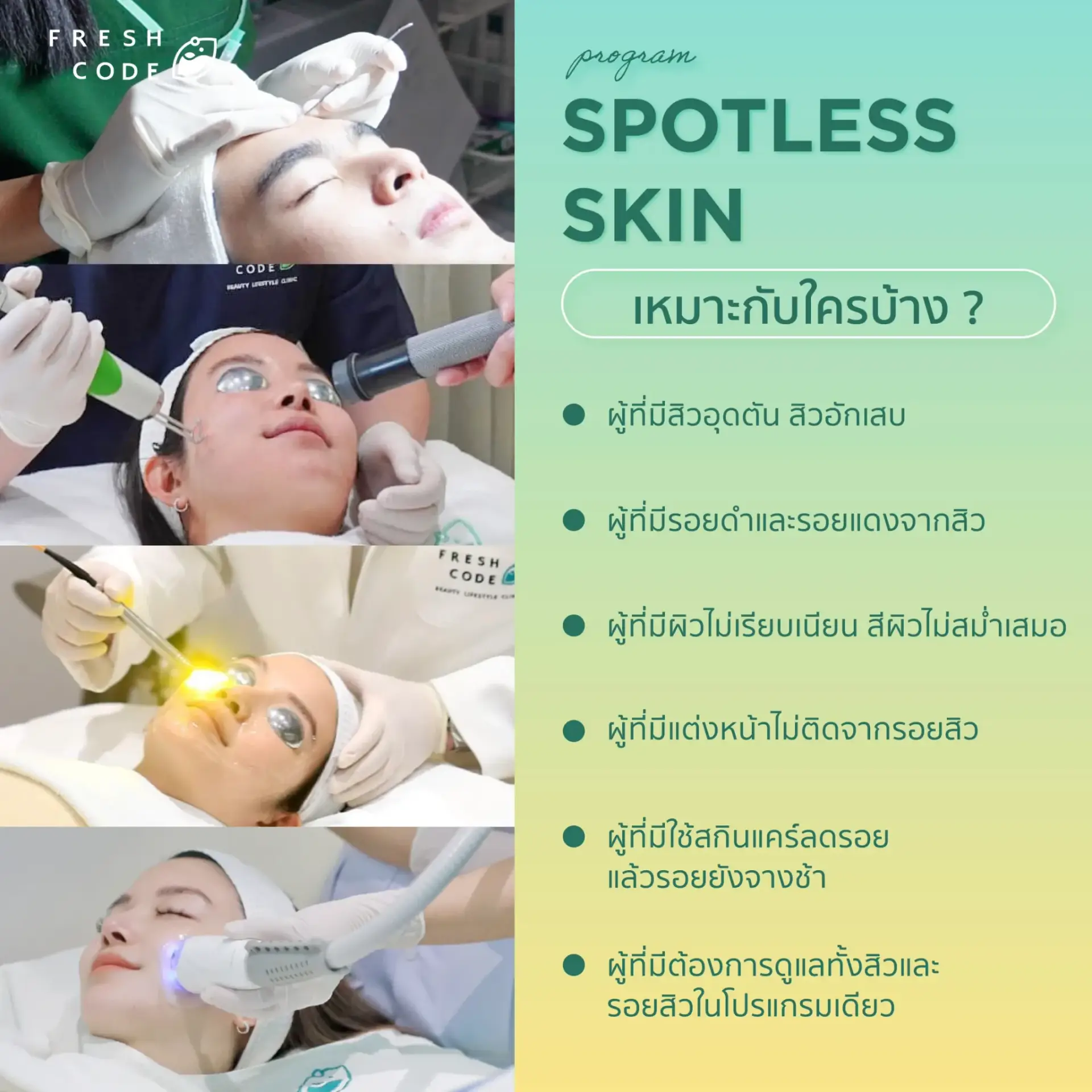
This program is suitable for individuals with clogged pores or recurring inflammatory acne, as well as those with multiple red and dark marks remaining after treatment, and those whose acne has subsided but whose skin tone remains uneven. For individuals with deep inflammatory acne, scarring, or other co-existing skin problems, a doctor will always assess whether this program is appropriate or if those existing problems should be addressed first.
In addition to Spotless Skin, the clinic also offers... Acne Code Treatment Program There are 4 packages to choose from, based on your acne and skin type. A doctor will help assess which package is most suitable; you don't necessarily have to choose the most intensive one.[3]
| Package | together with | Suitable for |
|---|---|---|
| Acne Exit | Unlimited acne extraction and injection, Dual Yellow Plus+, Vitacool. | Various types of acne, both clogged and inflammatory, appear in multiple areas, leaving red or dark marks, and the skin needs to recover. |
| Acne Clear | Algy Peel Off Mask (Acne Formula), OMG LED Light Therapy | Early stage acne; clogged pores or mild inflammation. |
| Acne Clear Plus | Algy Peel Off Mask, OMG LED Light Therapy, Fresh Beam Laser | Inflamed acne, oily skin, large pores, recurring acne in the same spot. |
| Acne Clear Dual | Algy Peel Off Mask, OMG LED Light Therapy, Dual Yellow Plus+ | Prominent post-acne redness; uneven skin texture and tone. |
See all services in the category. Treating acne and acne scars. Or get to know the medical team on the counter. Our doctor
Preparation and skin care after the Spotless Skin program.
The results don't depend solely on the day you visit the clinic. Pre-treatment preparation and post-treatment care are equally important, starting with the period before the procedure.
- Please specify the skincare products you are currently using, acne medication, any recent procedures you have undergone, and any history of drug allergies.
- Please report any redness, burning, peeling, irritation, or recent sunburn.
- Avoid picking or squeezing pimples before your appointment.
- If you are using AHA, BHA, retinoids, or products that irritate your skin, tell your doctor so they can consider whether you should stop using them.
After treatment, dark spots are particularly sensitive to sunlight, so the following should be observed:
- Apply sunscreen every day. Choose an SPF of 30 or higher and reapply when exposed to sunlight for extended periods. Reapply even indoors.[4][5]
- Wash your face gently. Use a gentle cleanser and a non-comedogenic moisturizer; avoid scrubbing vigorously.
- Do not peel, do not squeeze. Because it deepens the inflammation and increases the chance of acne scars and pits.
- Do not switch multiple products at once. If your skin is irritated, you won't know which substance is causing it.
- Don't rush back into using AHA, BHA, or retinoids. Just because the redness has faded, follow your doctor's instructions on your treatment day.
- Get enough sleep and manage stress. Because hormones and stress can contribute to recurring acne.
If the marks don't fade as expected, or the acne becomes severely inflamed, you should return for a doctor's reassessment instead of continuously adding products on your own.
FAQ (Frequently Asked Questions)
Q: Why do pimples keep appearing in the same spot?
Q: Are red marks and dark marks from acne treated the same way?
Q: Does Spotless Skin focus on treating acne or acne scars?
Q: If I still have acne, can I treat acne scars at the same time?
Q: Will one treatment completely remove redness and dark spots?
Q: Can I wear makeup after the procedure?
Conclusion
Acne scars and recurring acne are treatable, but it starts with identifying your primary skin problem: inflamed acne, redness, dark spots, or acne pits. Once you know, choose the right approach. Spotless Skin is one of the approaches Fresh Code Clinic uses to treat individuals with multiple problems simultaneously, ranging from clearing acne and treating dark spots and redness to skin rejuvenation. A doctor will assess and plan the treatment individually.
The information in this article is general knowledge and is not a diagnosis or guarantee of results. To determine which method is suitable for your skin, it is recommended to consult a doctor for a proper skin assessment.
References
- Discovery Pico — Fresh Code Clinic service page.
- Dual Yellow Plus+ — Fresh Code Clinic Service Page
- Acne Code Treatment Program — Fresh Code Clinic Service Page
- Article about acne scars, dark spots, and acne pits: types and treatment approaches — KTC
- Research on post-inflammatory hyperpigmentation after laser treatment and sunscreen use — PubMed Central.