Is XTherma painful? It is not a procedure where you feel nothing, because it is an RF skin tightening device that uses monopolar radiofrequency to heat tissue beneath the skin. You may feel the skin cool, alternating with warmth or heat in pulses, and the sensation varies by person and by treated area. This article covers what it feels like, numbing cream, how it compares with Thermage FLX, before and after photos, its limits and who may not suit it. It is general knowledge, not a diagnosis
Key Takeaways
- XTherma is not a procedure where you feel nothing, because it uses monopolar RF to heat beneath the skin. You may feel the skin cool, alternating with warmth, pulsing heat or deep heat. The sensation varies with pain sensitivity, treated area, tissue thickness and energy level.
- The cooling system helps manage skin temperature and comfort but does not remove sensation completely. On numbing cream, the doctor decides case by case, and you should not apply large amounts yourself. You should not endure unusual heat or pain and can tell the doctor straight away during treatment.
- No study testing XTherma directly was found. Information on pain and results comes from other RF devices such as Thermage and Oligio. The FDA document for 10THERMA lists electrocoagulation and hemostasis as its indications, not skin tightening, and a study of Thermage FLX in 46 patients found average pain scores of about 6.6–7.1 out of 10.
- The clinic’s before and after photos are real examples only, not results anyone can expect. People with marked sagging, mainly fat-related problems, strong fear of pain, or certain health conditions should have a doctor assess whether it suits them.
Is XTherma Painful? What It Feels Like and Why It Feels Hot
People who have felt uncomfortable with other energy devices often wonder whether XTherma hurts. According to the clinic’s service page, the sensation varies between people and between areas, and discomfort should not be used as a measure of whether the treatment works.[1]
The name XTherma is also the brand of a heat pump manufacturer in Germany.[13] This article refers only to XTherma, the RF skin tightening device for the face that the clinic offers.
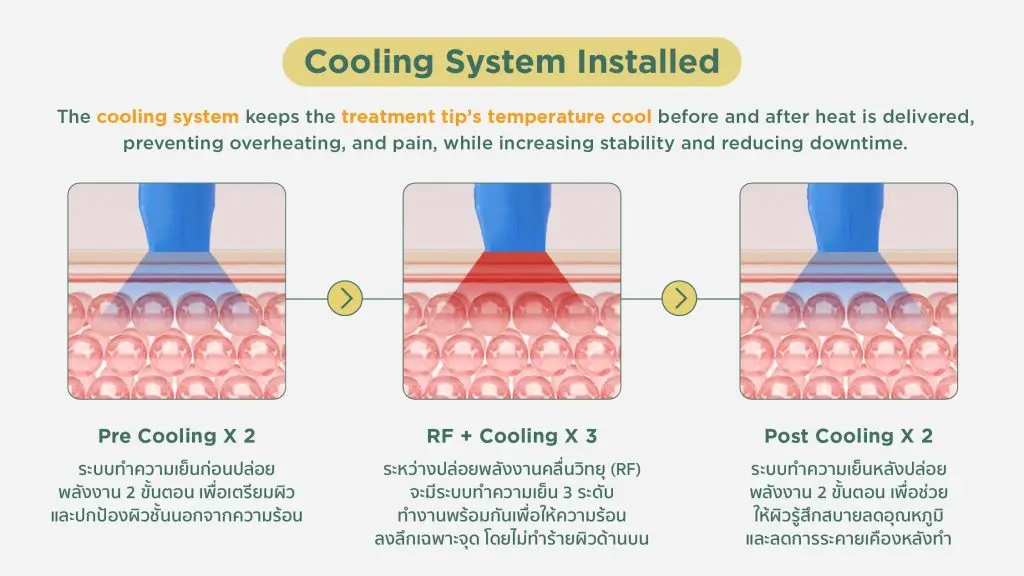
What XTherma Feels Like During Treatment
- Cool skin from the cooling system, alternating with warmth
- Heat in pulses with each energy shot
- Deep heat beneath the skin in some areas
- Some spots feel stronger than others, such as areas with thin tissue or close to bone
This list is summarized from the clinic’s service page.[1] Some people may feel only mild warmth, while others feel clear heat on certain shots.
Why XTherma Feels Hot
XTherma is a monopolar RF device operating at 6.78 MHz. A treatment tip and a return pad let current pass through tissue, producing heat from resistance. The heat is meant to be controlled, not maximized, and must be adjusted to the area, tissue thickness, fat volume and skin condition.[1] In English, this group is often called monopolar radiofrequency treatment. Heat in tissue is the same principle that drives collagen remodeling in RF and ultrasound tightening technologies.[3]
A small study gives a picture. In an observational study of 20 patients treated with Thermage CPT monopolar RF on the cheeks, jawline and upper neck, 70% described the sensation as warm and 30% as mild to moderately hot. No side effects were seen.[4] Note that this is a different model from XTherma, the sample is small and there is no comparison group, so it only shows that monopolar RF generally feels like heat. It is not a figure for XTherma.
On the other side, a US business news article quotes a LaserAway executive saying XTherma is almost painless, but this is a distributor’s statement without independent clinical data.[2] Advertising claims like this should not be used to judge how it will feel for you.
Why People Feel It Differently and Which Areas Feel Stronger
Other people’s reviews predict your experience only to a limited degree, because sensation depends on several factors at once. The table summarizes the main factors and what to tell the doctor before starting.
| Factor | How it affects sensation | What to tell the doctor |
|---|---|---|
| Pain sensitivity | Everyone has a different threshold, and very sensitive people may feel it more | Say before starting if you are sensitive to pain or afraid of it |
| Treated area | Cheeks, lower face, jawline, under the chin and neck have different structures | Say right away if a spot feels stronger than usual |
| Tissue thickness | Areas with thin tissue or close to bone may feel different from fuller cheeks | The doctor assesses from your facial structure and tissue |
| Energy level | Should be adjusted by area, not set the same across the whole face | Say if any shot is much hotter than the one before |
| Anxiety and past experience | A bad experience with other energy devices, or worry, can make sensation feel stronger | The point about thin or near-bone tissue comes from the clinic’s service page. |
Information regarding thin or near-bone tissue is from the clinic's services page.[1] The other factors are general guidance that doctors weigh case by case.
Which Areas May Feel Stronger
No area is the most painful for everyone. Areas people often ask about are the cheeks, lower face, jawline, under the chin and neck. Areas with thin tissue or close to bone may feel different from areas with more tissue.[1] Telling the doctor how it feels during treatment matters more than trying to guess in advance.
Energy Level and Comfort
Data from other RF devices show that energy adjustment affects comfort. In a 2019 ASLMS conference presentation using ThermaCool in 66 adults, several passes at low energy were used instead of one high-energy pass, and energy was lowered when patients reported strong discomfort. The authors considered this more comfortable.[6] Weiss and colleagues, reviewing more than 600 treatments, also moved over time to several passes at lower energy and linked this to better results and greater patient acceptance.[5] Both used devices other than XTherma, so these are general concepts, not direct XTherma results.
How XTherma’s Cooling Helps and How It Compares With Thermage FLX
The clinic’s service page describes Smart Temperature Cooling as cooling the upper skin to control skin temperature while energy is delivered. Each shot has 7 cooling pulses: 2 before RF, 3 during RF and 2 after RF.[1] A business news article about the device says it pairs RF with cryogen cooling.[2]
Cooling helps skin temperature and comfort but does not remove sensation, because monopolar RF still relies on heat inside the tissue. The Thermage CPT study also lists adding cryogen cooling as part of a system upgrade but does not report how much it reduced discomfort.[4] Cooling should therefore not be read as meaning no pain.
How XTherma and Thermage FLX Differ for the Face
Anyone searching thermage flx or xtherma (face), or weighing the two for the face, should know both are monopolar RF devices. The FDA 510(k) document for 10THERMA from Tentech, which the clinic’s service page uses as its reference for XTherma, names the Thermage FLX System as its predicate, with the same 6.78 MHz frequency, 400 W maximum average power and monopolar electrode type.[1][8] The difference in the documents is the indications: for Thermage FLX they include non-invasive treatment of wrinkles and rhytids,[9] while the 10THERMA summary lists only electrocoagulation and hemostasis.[8] Being a predicate does not mean results or sensation are the same, and no study directly comparing the two devices on results or pain was found in the sources that could be read, so it cannot be said which suits the face better. Thermage FLX pain data are in the numbing cream section below.
Does XTherma Need Numbing Cream? And What to Do If It Gets Too Hot
About Numbing Cream
There is no single answer for everyone. The clinic’s service page does not state use of topical or other anesthesia; only the cooling system is given as comfort information.[1] The decision should be made with the doctor case by case, and you should tell them in advance if any of the following apply.
- Afraid of pain or has a low pain threshold
- Sensitive to heat
- Had a lot of pain with other energy devices before
- The area to be treated is especially sensitive
- Tense or anxious before treatment
If the doctor recommends numbing cream, follow their instructions. Creams containing lidocaine, tetracaine, benzocaine or prilocaine can be absorbed through the skin into the bloodstream. An FDA advisory says misuse can cause irregular heartbeat, seizures, difficulty breathing, loss of consciousness or death. Users should avoid applying large amounts over wide areas, use only the strength needed, not use it on irritated or broken skin, and not cover it with plastic wrap or apply heat over it.[7]
For comparison, Weiss and colleagues concluded that ThermaCool monopolar RF can be done in the clinic without injected anesthesia or intravenous sedation.[5] That was a different device, so it does not mean XTherma will need no numbing for everyone.
Is Thermage FLX Painful Without the Use of Anesthetic Cream?
This question can only be answered in part, because no study directly comparing Thermage FLX with and without numbing cream was found in the sources that could be read. A prospective study of 46 patients treated with Thermage FLX on the face scored pain within 5 minutes after treatment on a 0–10 scale. The average was about 7.12 on the left side of the face and 6.62 on the right, with patients aged 42 or younger scoring higher than older patients. The abstract does not say whether anesthetic was used.[10] In a survey of 52 Korean dermatologists, about 25.5% found Thermage FLX more painful than the earlier CPT model.[11] The older Thermage CPT study reported only mild to moderate warmth to heat, and the page that could be read does not mention anesthetic.[4] These figures come from different models and different ways of measuring, so they cannot be compared directly with each other or with XTherma. All that can be said is that Thermage FLX may be painful enough that patients give high scores, and numbing should be decided with the doctor case by case.
What to Do If XTherma Gets Very Hot
You should not endure excessive heat, and you can tell the doctor right away during treatment. The table shows what to report immediately.
| What you feel during treatment | What to do |
|---|---|
| Warm or hot in pulses, alternating with cooling | Tell the doctor if you start to feel uncomfortable. The doctor can adjust by area |
| One shot is much hotter than the previous one | Tell the doctor right away |
| Pain, stinging, or a feeling of being burned | Tell the doctor right away and do not push through to the planned number of shots |
| Heat lingers longer than expected | Tell the doctor right away |
This follows the clinic’s article and agrees with the principle used in the conference report: lower the energy when the patient says they are very uncomfortable.[6]
Pain vs Results, Aftercare, and XTherma Before and After Photos
Is XTherma More Effective the More It Hurts
No. Pain is not an indicator of results. The service page says results depend on the treated area, tissue thickness, energy placement and each person’s structure, and collagen remodeling takes several weeks to months, so results are judged over a period, not by how it felt on the day.[1] Conversely, less pain doesn't mean it's ineffective.
Is There Still Pain or Stinging After XTherma
The review of more than 600 ThermaCool treatments also reported redness and swelling as the most common effects, usually gone within 24 hours, but that was a different device.[1] A review of over 600 treatments with ThermaCool reported that redness and swelling were the most common side effects, and usually subsided within 24 hours, but this was true for other device models.[5]
If pain increases, you have unusual burning, a wound, or symptoms that differ from the aftercare advice, contact the clinic for assessment.[1] The service page advises taking follow-up photos at similar angles, lighting and expression, and assessing results immediately after treatment, at about 1 month and at about 2–3 months.[1]
How to Read XTherma Before and After Photos
People searching xtherma before and after usually want to see how much changes. Below are two before and after sets the clinic has published on its XTherma service page.[1]
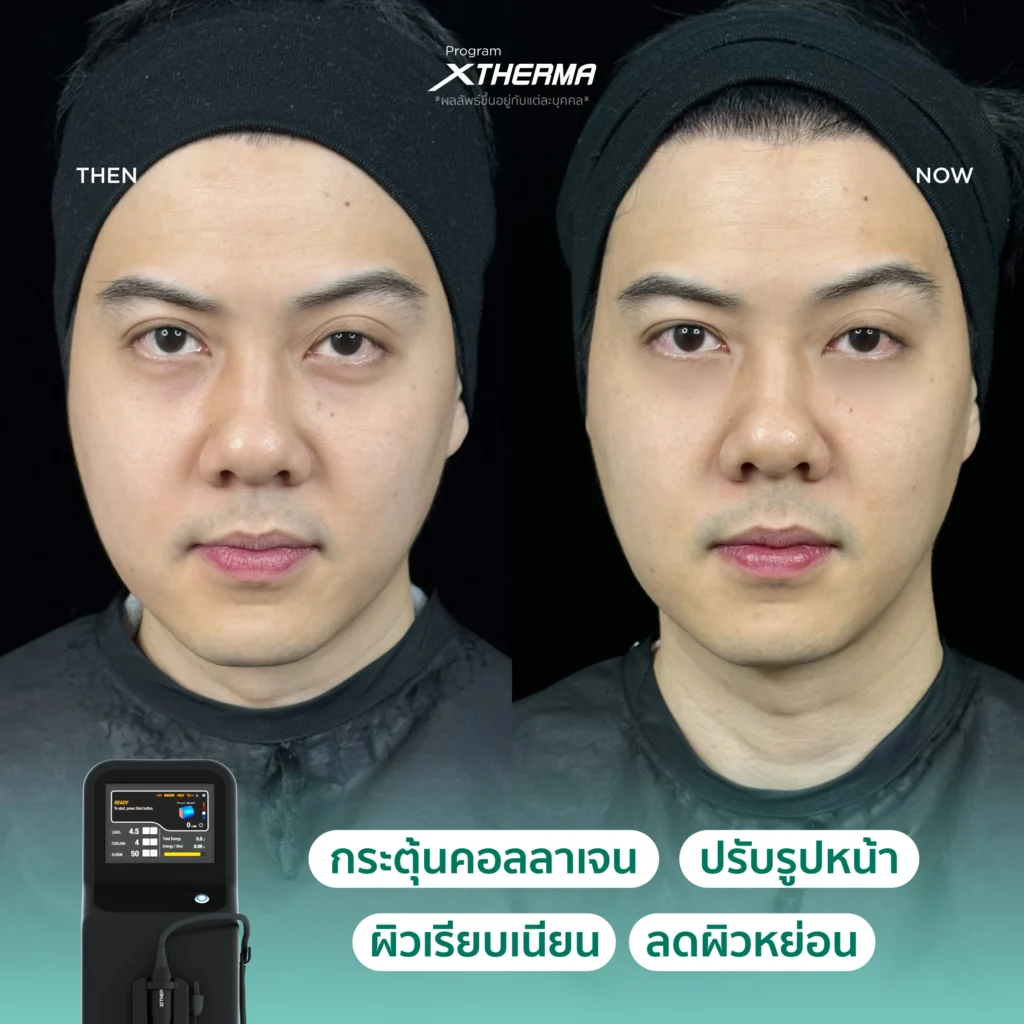
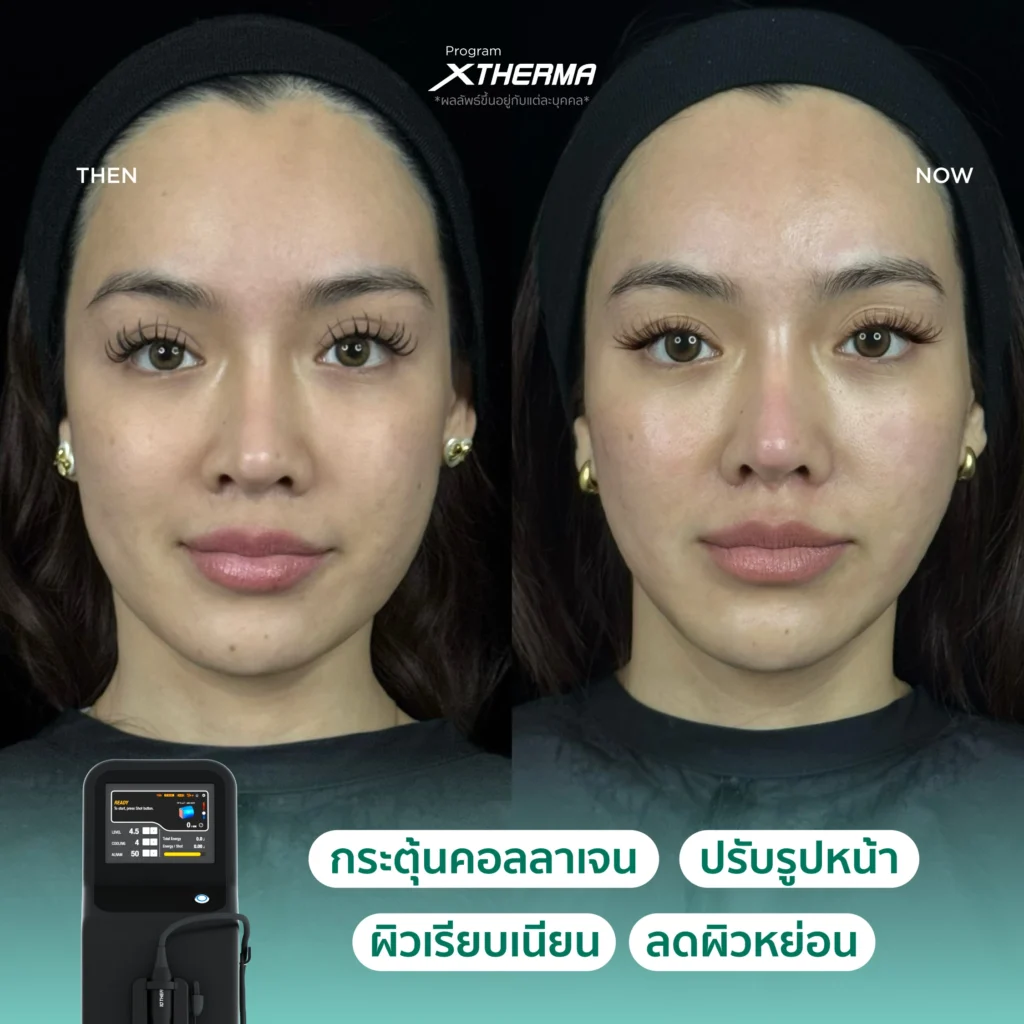
The clinic describes both sets as before and after results of XTherma treatment at Fresh Code Clinic. The text on the images is the clinic’s own description. The clinic does not state the age, time since treatment, number of shots or energy level for either person, and the images carry a note that results vary from person to person. They are examples only, not results anyone can expect.
Whenever you look at before and after photos, compare angle, camera distance, lighting, expression and hairstyle, as the service page advises.[1] Check that the photos are real cases published with the client’s consent, and how long after treatment they were taken, because collagen remodeling takes several weeks to months.[1]
As for evidence beyond the clinic’s own photos, no study testing XTherma directly was found. A study of Oligio, a different RF device, in 30 Thai adults found that most patients (86.67%) maintained improvement to month 6, and follow-up was only 6 months.[12] That is not an XTherma result and should not stand in for any one person’s photos.
XTherma’s Limits and Who May Not Be Suited
To answer directly: XTherma is not the right choice for everyone, and there are limits worth knowing before deciding. This section covers the limits of the data and the device, who may not suit it, and how to read online reviews.
XTherma’s Limits to Know
- No study testing XTherma directly was found. Searching PubMed for XTHERMA, 10THERMA and Tentech together with radiofrequency returned no results. Information on results, pain and duration comes from other RF devices such as Thermage and Oligio.[4][5][12]
- The FDA 510(k) document for 10THERMA lists electrocoagulation and hemostasis as indications, and does not mention skin tightening or wrinkles.[8]
- It is not a procedure where you feel nothing. A Thermage FLX study of 46 patients found average pain scores of about 6.6–7.1 out of 10. That is a different model, but it shows monopolar RF can be quite painful for some people.[10]
- Results are gradual, and the Oligio study cited followed patients for only 6 months. There are no long-term data for XTherma.[12]
- Devices in this group are not a substitute for surgery. Reviews say they suit mild to moderate laxity.[3]
- No research specific to the neck was found, as the clinic’s service page states.[1]
Who May Not Be Suited, or Should Be Assessed First
This article cannot say who can or cannot be treated, because the FDA document for 10THERMA that was found lists no contraindications or warnings.[8] The list below comes from the clinic’s service page, which asks you to tell the doctor before treatment. These items do not automatically rule you out, but the doctor must assess them.[1]
- Open wounds or inflammation in the treatment area
- Underlying medical conditions
- Implanted electronic devices
- Metal or medical materials in the treatment area
- Pregnancy
- Recent injections or thread lifts in the same area
- Recent other energy-based treatments
- Previous facial or neck surgery
- Unusual sensation on the face
Beyond this list, some groups may gain less or may not suit XTherma as a first choice. These include people with marked sagging or excess skin, because devices like this are not a substitute for surgery;[3] people whose main problem is fat under the chin or lower cheeks, as the service page says that with more fat another treatment may be needed alongside;[1] people with a strong fear of pain who do not want to feel any heat, because monopolar RF can be quite painful in some people;[10] and people who want a clearly visible result within a day, because results change gradually.[1] The Korean dermatologist survey says skin thickness is an important determinant of response to Thermage FLX, but that is an opinion survey, not a direct measurement.[11]
How to Read Negative Reviews and Reddit Threads About XTherma
People searching xtherma treatment reviews negative or xtherma treatment reviews reddit usually want to know what dissatisfied patients complain about. No independent, verifiable reviews or user threads about XTherma were found in the sources that could be read. What was found is a US distributor’s statement that it is almost painless, which is not an independent review.[2] It would be wrong to conclude from this search that negative reviews do or do not exist.
Issues that general RF data suggest could leave people dissatisfied include heat or pain during treatment,[10] results that are gradual and differ from person to person,[1][12] and less obvious results in people with marked sagging.[3] These come from studies of other RF devices, not from XTherma users’ accounts. When reading online reviews, check which device is actually named, since the XTherma name is shared with another product,[13] and look at the number of shots, treated area and time since treatment. A single review is not medical information.
Can People Afraid of Pain Have XTherma? And How the Clinic Looks After You
Fear of pain does not disqualify you from an assessment. Tell the doctor before starting, especially if you have never had an energy-based treatment, are sensitive to pain, have had a lot of pain with HIFU or RF elsewhere, are sensitive to heat, or tense up easily during procedures.
Questions to ask the doctor before starting:
- How will the plan accommodate my pain sensitivity?
- Can I tell you straight away if I feel heat or pain during treatment?
- Do I always have to complete the planned number of shots, or can it be adjusted to how I feel?
At Fresh Code Clinic, the doctor assesses each case, looking at tissue thickness, fat, facial structure and pain sensitivity, then adjusts energy for each area. You can report how you feel throughout treatment and do not need to endure it to complete the number of shots. The aim is to place energy appropriately, not to cause as much pain as possible. The clinic states that Dr. Kritimuk Viseththanakorn (Dr. Krit) is a Trainer and Speaker for XTherma and XTriple.
If you are still unsure about the pain, read more comparisons in the article What are the differences between Ulthera Prime and Xtherma? and let the doctor assess which device suits you.
FAQ (Frequently Asked Questions)
Q: Is XTherma painful ?
Q: Does XTherma need numbing cream ?
Q: If XTherma gets very hot during treatment, should I put up with it ?
Q: Is Thermage FLX painful without anesthetic cream ?
Q: Thermage FLX or XTherma for the face, which is better ?
Q: What are XTherma’s limits, and who may not suit it ?
Conclusion
Is XTherma painful? It is not a procedure where you feel nothing. You may feel the skin cool, alternating with warmth or heat in pulses, and this varies with the person, the area, tissue thickness and energy level. Cooling helps comfort but does not remove sensation. More pain does not mean a better result, and you should not endure unusual heat or pain. A key limit is that no study testing XTherma directly was found, and people with marked sagging, mainly fat-related problems, strong fear of pain, or certain health conditions should have a doctor assess them first.
For anyone searching facial clinic near me open now, Fresh Code Clinic is on Sukhumvit Soi 5, near BTS Nana, and is open daily 11:00 – 20:00, though you should check the latest opening hours before travelling. The doctor assesses each case and adjusts energy for each area. The information in this article is general knowledge, not a diagnosis or a guarantee of results. For more information, consult a doctor for an assessment first.
References
- What is XTherma? How much does it cost? How many shots are included, and what are its benefits? — Fresh Code Clinic
- BENEV and LaserAway expand access to XTherma device — Plastic Surgery Practice
- Skin tightening technologies — Facial Plastic Surgery
- Tolerability of a Monopolar Radiofrequency Facial Skin Tightening Procedure: An Observational Study — Cutis
- Monopolar Radiofrequency Facial Tightening: A Retrospective Analysis of Efficacy and Safety in Over 600 Treatments — Journal of Drugs in Dermatology
- Multiple RF passes reduce laxity, spare pain — MDedge Dermatology News
- FDA Issues Public Health Advisory Alert on Skin Numbing Products — OHS Online
- 510(k) Summary K232992, 10THERMA (Tentech, Inc.) — U.S. Food and Drug Administration
- 510(k) K170758, Thermage FLX System (Solta Medical) — U.S. Food and Drug Administration
- Evaluation of the Effect of Laterality and Age on Pain Perception in Monopolar Radiofrequency Facial Therapy — Clinical, Cosmetic and Investigational Dermatology
- A survey on monopolar radiofrequency treatment: The latest update — Dermatologic Therapy
- Efficacy and Safety of Monopolar Radiofrequency for Treatment of Lower Facial Laxity in Asians — Dermatology and Therapy
- Xtherma Wärmepumpen (ผู้ผลิตปั๊มความร้อน ประเทศเยอรมนี)