



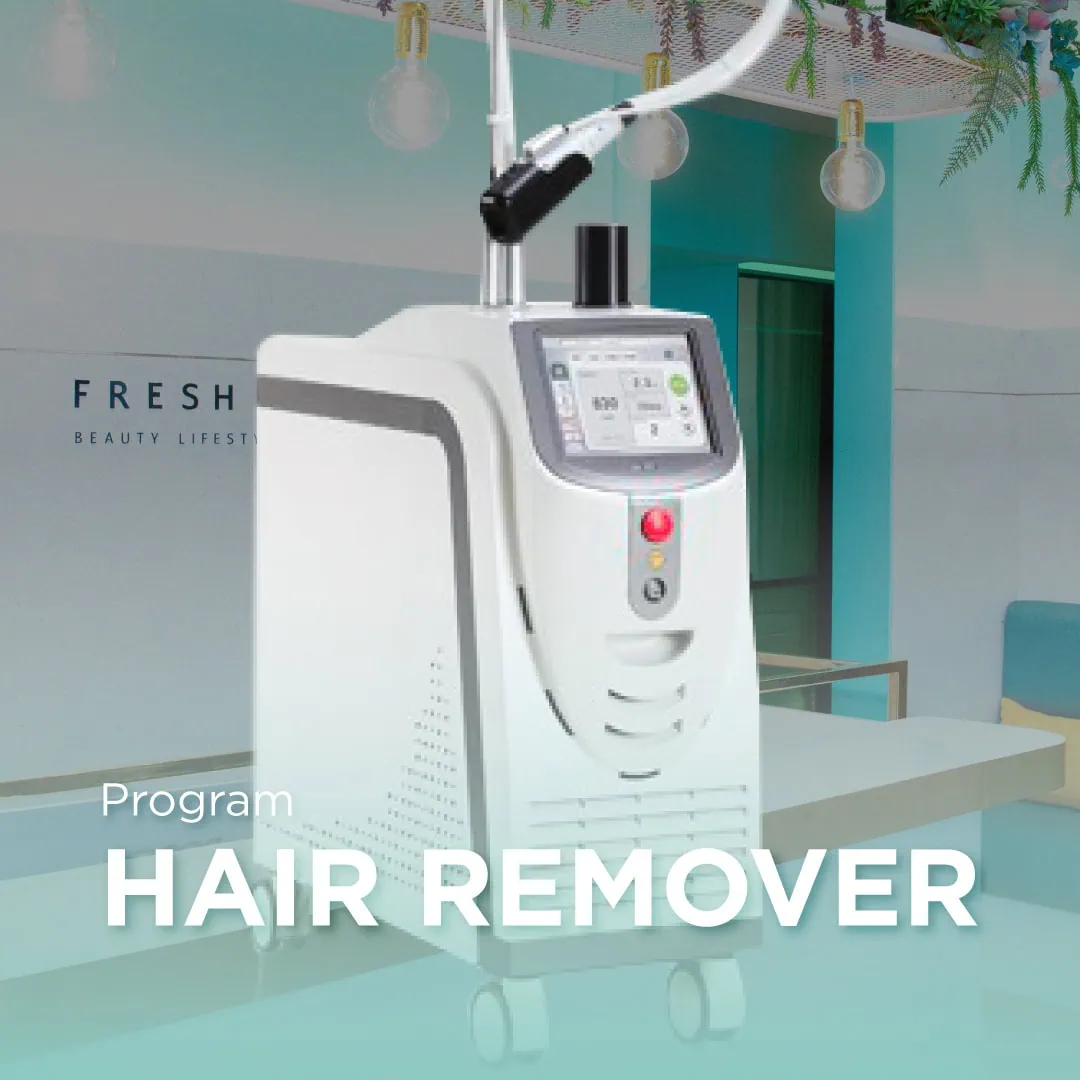
Hair Removal Laser Hair Removal
Hair Removal is a laser hair removal service offered by Fresh Code Clinic using an Nd:YAG machine. This page summarizes what the clinic states, the supporting evidence, what "permanent" means, and things you should ask before starting the procedure.
Key Takeaway
- There are several studies on hair removal using the Nd:YAG 1064 nm wavelength in darker skin tones (III–VI), but no data was found on the Mercury device, and no studies were found on the 1320 nm wavelength for hair removal.[1][2]
- Results improve with the number of treatments: After 6 treatments, 56% of 59 people showed improvement in downy hair, while 20% showed no change. In a study of 15 people who likely received only one treatment, hair loss was approximately 27–29%.[2][3]
- “"Permanent," as defined by the FDA, means a steady decrease in the amount of new hair growth; it doesn't mean there's no hair left at all.[4]
- No evidence was found to support the claims of "painless," "scarless," and "brighter skin."“
- You should ask about the device model, FDA registration number, number of uses, and the risk of hyperpigmentation for your skin tone.
What is hair removal with an Nd:YAG laser?
According to the clinic, Fresh Code Clinic's hair removal service uses a Mercury Long Pulsed Nd:YAG laser with wavelengths of 1064 and 1320 nm. The 1064 nm Nd:YAG laser is considered suitable for darker skin tones because of its long wavelength, and there are several studies supporting its effectiveness on skin types III–VI.[1][2]
I searched and found no information on the device named “Mercury Long Pulsed Nd:YAG” (manufacturer, model, or FDA documentation), nor any studies using the 1320 nm wavelength for hair removal. The research cited on this page only uses the 1064 nm Nd:YAG wavelength. The clinic should be asked to provide the manufacturer, model, and Thai FDA registration number, as well as explain how the 1320 nm wavelength is used for hair removal.
How much hair can be removed, and what is the verifiable evidence?
| The results indicated by the clinic. | Examinable evidence |
|---|---|
| Remove hair quickly with fast results. | A study of 15 people using Nd:YAG (Goldberg 2001 abstract, number of sessions not specified, likely a single session) showed a hair loss of approximately 27–291 TP3T at 3 months.[3] In a study of 6 treatments (59 people, IV–V skin types), those who had developed tufts of hair showed improvement with 5% at the 3rd treatment and 56% after the 6th treatment, with increasing improvement in the number of treatments.[2] |
| Permanent hair removal / Hair roots are completely destroyed. | See the section "What does permanent mean?" below. In a study of 59 people after 6 treatments, 56% showed improvement in downy feathers, 23% showed partial improvement, and 20% showed no change.[2] |
| It can remove even the finest, softest hairs. | In the study of 59 people, intermediate-type hair responded less than coarse-type hair. Approximately half of the intermediate-type hair group showed no change.[2] No studies were found that specifically examined downy feathers. |
| Suitable for Asian skin / dark skin tones. | A meta-analysis of 12 studies (Skin III–VI) concluded that the overall effects of different laser types and IPL were similar, and Nd:YAG caused less post-inflammatory hyperpigmentation than IPL.[1] |
| No pain during the procedure (Smooth Pulse) | A meta-analysis reported that laser pain scores were higher than IPL pain scores.[1] No information was found for Smooth Pulse. |
| Makes skin brighter than before. | No studies were found that examined this topic in the context of hair removal. |
| It can be done on any part of the body. | No examination has been done. You should ask your doctor if the area you wish to have the procedure done is suitable. |
Most of the cases observed were small, individual studies with no control groups, using a standard 1064 nm Nd:YAG laser, not a clinical Mercury laser.
“What does "permanent" mean?
The US FDA authorizes the use of the term “permanent hair reduction” for certain devices. The commonly reported definition is a steady reduction in the amount of hair that grows back over a period longer than one hair growth cycle (4–12 months depending on the location), and it does not mean that all hair is completely removed.[4] (This definition was read from a secondary website, not the original FDA document.) Therefore, the terms "permanently gone" or "completely destroys the hair follicle" go beyond this definition.
In practice, expect hair to thin and grow slower after several treatments, and subsequent touch-ups may be necessary. Results depend on hair color and thickness, location, and hormones.
Precautions and things to tell your doctor.
People with darker skin are more likely to experience side effects from laser treatments.[1] In the study, 15 people experienced temporary blisters, 2 did not develop them, and no dark spots, white spots, or scars were observed after 3 months.[3] In the study of 59 people, no permanent side effects were found.[2] The term "leaving no trace" is not yet supported by evidence.
Before treatment, inform your doctor about: skin color and history of post-inflammatory hyperpigmentation, tanned or recently sun-exposed skin, medications you are taking (especially photosensitizing medications), skin infections, pregnancy, and underlying medical conditions, as well as your shaving and skin care routine before and after treatment. Actual contraindications depend on the device instructions and your doctor's assessment.
Things to ask before starting.
- Manufacturer, model, and Thai FDA registration number of the device, and is the 1320 nm frequency used for hair removal?
- How well does the hair in the area to be treated (color, thickness) respond, and how many sessions are needed?
- The expected results include the percentage of hair thinning and when additional treatments may be needed.
- The risk of post-inflammatory hyperpigmentation for our skin tone, and post-treatment care, including sun protection.
- Areas where procedures can and cannot be performed. Are before-and-after photos of patients at the clinic available (with informed consent)?
FAQ: Frequently Asked Questions about Hair Removal
What is hair removal at Fresh Code Clinic?
Is laser hair removal truly permanent?
How many laser hair removal sessions are needed?
Can people with dark skin get laser hair removal?
Is laser hair removal painful?
Consult about hair removal.
Consult about hair removal at Fresh Code Clinic.
Have a veterinarian assess your individual skin and hair condition, inquire about device models and precautions via LINE @freshcodeclinic or at Fresh Code Clinic before making a decision.
Add LINE @freshcodeclinic Consult a doctor.
- Address: 19 Sukhumvit Soi 5, BTS Nana Exit 1 (Parking available)
- telephone: 083-626-4264
- Opening hours: Open daily 11:00–20:00
References
- Dorgham NA, Dorgham DA. Lasers for reduction of unwanted hair in skin of colour: a systematic review and meta-analysis. J Eur Acad Dermatol Venereol. 2020;34(5):948-955. doi:10.1111/jdv.15995. (Includes 12 comparative studies, Fitzpatrick III-VI skin, read from abstracts, funding sources/COI not checked) https://pubmed.ncbi.nlm.nih.gov/31587390/
- Mittal R, Sriram S, Sandhu K. Evaluation of long-pulsed 1064 nm Nd:YAG laser-assisted hair removal vs multiple treatment sessions and different hair types in Indian patients. J Cutan Aesthet Surg. 2008;1(2):75-79. doi:10.4103/0974-2077.44163. (59 women, IV-V skin, 6 treatments, no control group, no funding source/COI) https://pmc.ncbi.nlm.nih.gov/articles/PMC2840900/
- Goldberg DJ, Silapunt S. Hair removal using a long-pulsed Nd:YAG laser: comparison at fluences of 50, 80, and 100 J/cm2. Dermatol Surg. 2001;27(5):434-436. doi:10.1046/j.1524-4725.2001.00329.x. (15 people, probably done once (abstract not specified), measured at 3 months, read from the abstract in Mahidol archive, did not check funding source/COI, skin color not specified in the abstract) https://repository.li.mahidol.ac.th/entities/publication/abd6c40c-d279-448d-968e-9f30b1f734b8
- Quackwatch. Hair removal: definitions (This is a secondary website citing the US FDA's definition of "permanent hair reduction," not the original FDA document.) https://quackwatch.org/related/hair/definitions/
Information stating "as specified by the clinic" has not been verified against the documentation for the actual model used by the clinic.
The information on this page is general and not medical advice. Treatment outcomes and suitability vary from person to person. Consult a doctor before making any decisions.