



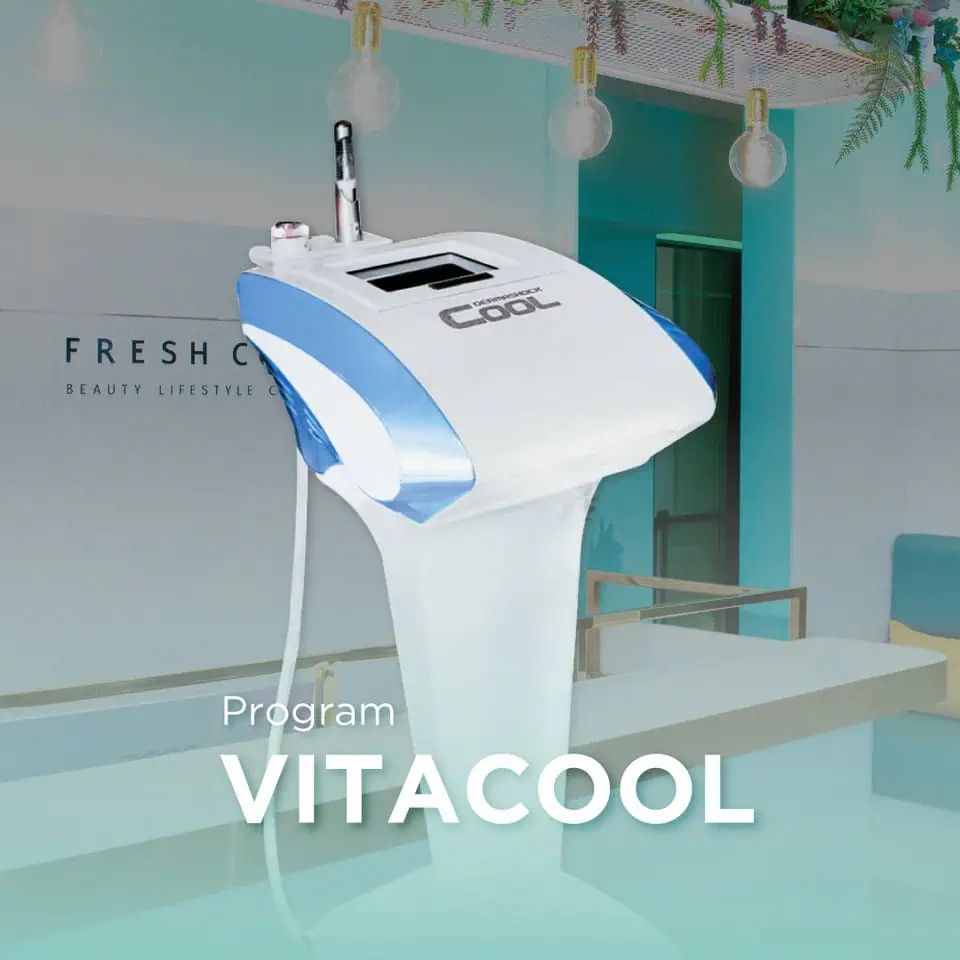
Vitacool pushes vitamins into the skin using cold technology.
Vitacool is a service offered by Fresh Code Clinic that delivers vitamins and skin nutrients into the skin using cold temperatures and electrical charges. This page summarizes what the clinic states, the verifiable evidence supporting its claims, the terminology used, and things to ask before starting the procedure.
Key Takeaway
- According to the clinic, Vitacool uses cold and electrical charges to help deliver vitamins into the skin, in combination with light therapy. The manufacturer, model, or FDA registration number of the device has not been found.
- No direct research was found on Vitacool, nor was there any research demonstrating that the substance reaches the “cellular level” or that cold temperatures deliver the substance better than regular topical application.[1][2]
- The closest thing to treatment was iontophoresis with vitamin C (17 out of 24 people completed it), which showed improved hydration at week 4, not "immediately," and the device used was different.[2]
- The ingredients and concentrations of the 11 formulations have not yet been specified. Vitamin C is unstable and difficult to absorb into the dermis.[3]
- A PDT requires a photosensitive substance, light, and oxygen.[4] You should ask whether Vitacool uses photosensitizing agents and request the registration number before making a decision.
What is Vitacool?
According to the clinic, Fresh Code Clinic's Vitacool is a service that uses cold and electrical charges (Ion+ and Ion−, also known as Cool Mesoporation) to help deliver vitamins and nutrients into the skin, followed by a light therapy treatment called PDT, with over 11 formulas to choose from based on skin concerns.
The name Dermashock Cool appears in the title of a video clip from the clinic, but there is no information available regarding the manufacturer, model, or FDA registration number of the device actually used. Therefore, it is not possible to identify the type of device. This page is therefore divided into what the clinic states and what can be verified with evidence.
The results indicated by the clinic, versus the evidence obtained through examination.
| The results indicated by the clinic. | Examinable evidence |
|---|---|
| Pushes vitamins into the skin, providing deep nourishment at the cellular level. | The outermost layer of the epidermis is the primary barrier against external substances, and only certain molecules can penetrate the skin in usable quantities. Techniques such as iontophoresis and electroporation assist in their delivery.[1] Vitamin C is an unstable substance and difficult to transport into the dermis in adequate amounts.[3] No studies were found that measured Vitacool's ability to deliver substances to the cellular level. |
| Applying it alone will show slow results; you need to use cold to boost the effect. | No studies were found comparing the use of cryotherapy for delivery with conventional application. The studies found were about iontophoresis, which is not related to cryotherapy.[2] |
| Over 11 natural vitamin C/skin supplement formulas, tailored to address specific skin problems. | The ingredients and concentrations of each formula are not yet specified, so individual formulas cannot be evaluated. Specifically, topical vitamin C supplements have been reviewed and suggest they may help with sun-induced aging and melanin-related hyperpigmentation.[3] The term "from nature" doesn't necessarily mean it's safer or more effective. |
| Just as good as counter-brand creams. | No comparisons were found between this product and any other brand. |
| Instantly moisturizes skin (clip title) | A split-face trial using a handheld iontophoresis device with Vitamin C (24 participants, 17 completed according to the protocol) showed significantly improved skin hydration at week 4 compared to before the start, and pore tightening at weeks 2 and 8. Results were not "immediate".“[2] |
| PDT light therapy | PDT, by medical definition, must include a photosensitizer, light, and oxygen.[4] This page does not specify the photosensitizer, so it is unknown whether it was true PDT or general light therapy. |
The only study found that used iontophoresis in combination with vitamin C in humans was a small-scale study, used different equipment, lacked refrigeration, and was only reviewed from the abstract.[2] Therefore, it cannot be used to confirm the results of Vitacool. No research directly related to Vitacool or Dermashock Cool was found.
What do Cool Mesoporation, Ion+ / Ion−, and PDT mean?
“"Mesoporation" is not a standard term in academic sources; it's often used as a marketing name for needle-free mesotherapy devices. Scientifically, there are two similar concepts: iontophoresis, which uses weak electrical currents to push charged substances through the skin, and electroporation, which uses short bursts of high-voltage electrical pulses to temporarily open the skin.[1] The information available does not specify the mechanism Vitacool uses, or the voltage or current levels.
Regarding cold therapy, there is no research demonstrating that cold helps or reduces substance delivery through the skin. Therefore, you should ask the clinic what the purpose of the cold therapy is, such as reducing discomfort or redness after treatment, as there is currently no verifiable evidence on this page.
PDT involves using a photosensitizing agent present in tissue along with light of a matching wavelength and oxygen.[4] The most studied indications are for precancerous skin lesions and some types of skin cancer. There are few randomized controlled studies on its use for acne and sun-induced skin aging.[4] If Vitacool uses only LED light without a photosensitive agent, it should be called phototherapy, not PDT.
Formulations, quantities, FDA registration numbers, and usage with other products.
The clinic states that there are over 11 formulas available, but this page does not yet display a list of ingredients, concentrations, manufacturers, or cosmetic registration numbers/product registration numbers. Therefore, you should request this information before choosing a formula.
- A complete list of all ingredients to be used in the formula (as per the INCI label) and the concentration of the active ingredient, such as which type of vitamin C and what percentage.
- The manufacturer/importer, the cosmetic registration number or Thai FDA registration, and whether the product is authorized for use with this type of delivery device have all been checked. (The Thai FDA database has not yet been directly checked, and general searches have not yielded information about the device.)
- How should the product be stored and when should it be opened? Because L-ascorbic acid, a form of vitamin C, is unstable, especially when exposed to light.[3]
- Using this product in combination with other topical medications and products, such as retinoids, exfoliating acids, or other topical drugs, may increase skin penetration and cause greater irritation. Specific information on these formulations is not yet available; a doctor should assess each individual case.
- History of allergy to any substance, fragrance, or preservative.
Precautions and things to tell your doctor.
A review of electroporation indicates that the use of high-voltage electrical pulses may have drawbacks in some cases, therefore safety must always be considered.[1] The iontophoresis with vitamin C treatment showed no reported adverse effects in the abstract, but this was due to different device models and small sample sizes.[2] There are no safety reports available for Vitacool. Therefore, claims such as "no side effects" or "safe for all skin types" lack supporting evidence.
Before treatment, inform your doctor about: any history of allergies to skincare products or ingredients in the formula; open wounds, infections, or rashes; pregnancy or breastfeeding; use of retinoids, exfoliating acids, or photosensitizing medications; implanted electrical or metal devices (such as pacemakers); and allergies or sensitivity to cold. The exact contraindications depend on the device instructions and your doctor's assessment.
Things to ask before starting.
- Device name, manufacturer, model, and Thai FDA registration number (the clip specifies Dermashock Cool).
- Iontophoresis or electroporation are used; what is the purpose of cooling? And does phototherapy use photosensitizers?
- What are the recommended ingredients, at what concentrations, and does it have a registration number?
- What are the expected results? How many treatments are needed, how far apart should they be, and how long will the results last?
- Risks and symptoms that warrant a return visit to the doctor, including combination treatments with topical medications you are currently using.
- Is it possible to see before-and-after photos of patients at the clinic (with their consent)?
FAQ: Frequently Asked Questions about Vitacool
What is Vitacool?
Does Vitacool really push vitamins deep into the cellular level?
What evidence is there for the use of vitamin C in the skin?
Is the PDT in Vitacool the same as the PDT used to treat skin diseases?
Is Vitacool safe for all skin types?
Skin care consultation.
Consult Vitacool at Fresh Code Clinic.
Have your skin assessed individually by a doctor. Inquire about the device, formula, and precautions via LINE @freshcodeclinic or at Fresh Code Clinic before making a decision.
Add LINE @freshcodeclinic Consult a doctor.
- Address: 19 Sukhumvit Soi 5, BTS Nana Exit 1 (Parking available)
- telephone: 083-626-4264
- Opening hours: Open daily 11:00–20:00
References
- Ita K. Perspectives on transdermal electroporation. Pharmaceutics. 2016;8(1):9. doi:10.3390/pharmaceutics8010009. (Review article on transdermal electroporation. Not a human trial. Not a cosmetic study. Based on the abstract and initial content review, the author states there is no conflict of interest.) https://pmc.ncbi.nlm.nih.gov/articles/PMC4810085/
- Yan C, et al. Efficacy of handheld iontophoresis device in enhancing transdermal vitamin C delivery: a split-face clinical trial. J Cosmet Dermatol. 2022;21(2):698-706. doi:10.1111/jocd.14702. (24 people completed according to protocol, 17 people used a handheld iontophoresis device, not a Vitacool machine, no cooling, done twice a week for 8 weeks. Read from the abstract in the Mahidol archive, did not check the funding source/COI) https://repository.li.mahidol.ac.th/items/252a8513-79a2-4d5e-bdba-4f58bb1112ac/full
- Telang PS. Vitamin C in dermatology. Indian Dermatol Online J. 2013;4(2):143-146. doi:10.4103/2229-5178.110593. (Review article, not experimental study. Authors stated Source of Support: Nil and Conflict of Interest: None declared) https://pmc.ncbi.nlm.nih.gov/articles/PMC3673383/
- Issa MCA, Manela-Azulay M. Photodynamic therapy: a review of the literature and image documentation. An Bras Dermatol. 2010. (This review uses only the definition of PDT, read from the abstract and introduction; funding sources/COI were not checked.) https://www.scielo.br/j/abd/a/CcpZfpFQJYr4MdTygs8FpkF/?lang=en
Information stating "as clinic-reported" has not been verified against documentation for the device and products actually used in clinics. No direct research was found for Vitacool or Dermashock Cool.
The information on this page is general and not medical advice. Treatment outcomes and suitability vary from person to person. Consult a doctor before making any decisions.