
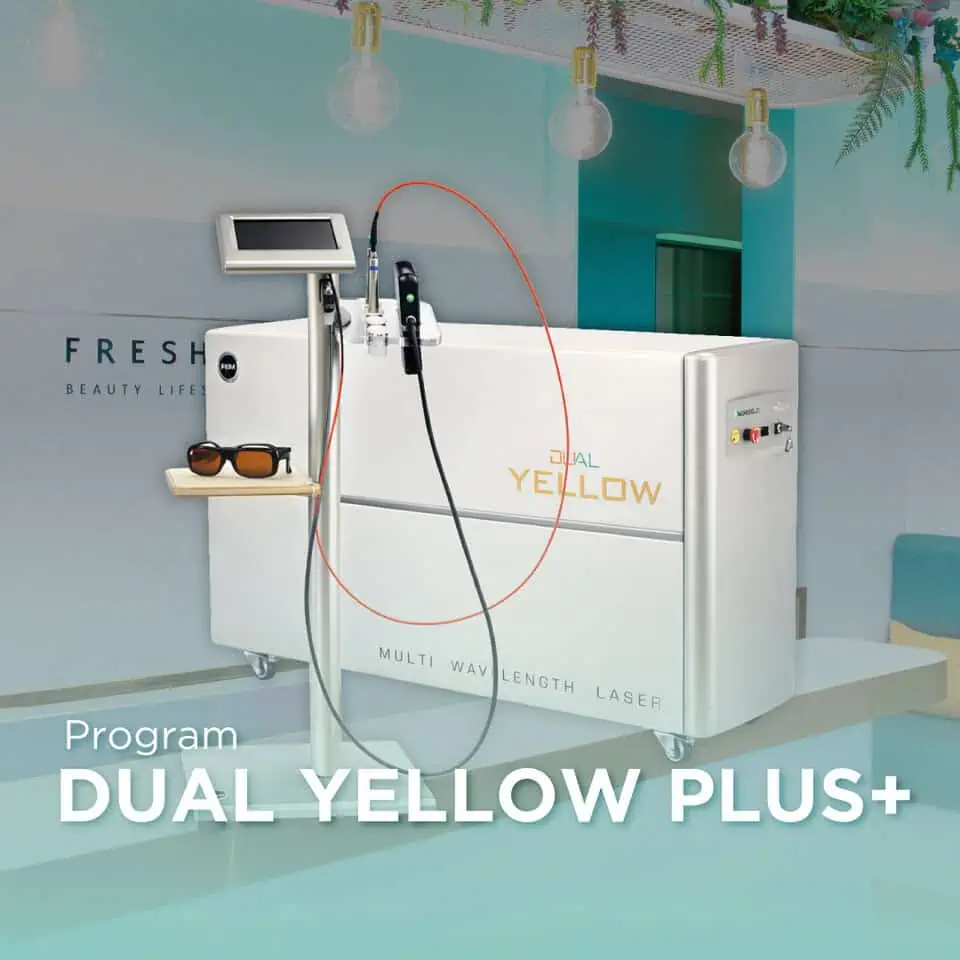
Dual Yellow Plus+
Dual Yellow Plus+ is Fresh Code Clinic's dual-wavelength laser program used to treat redness from blood vessels and certain types of dark spots. This page summarizes what the clinic states and the supporting evidence for each claim.
Key Takeaway
- Dual Yellow is a Norseld copper bromide laser that emits yellow light at 578 nm and green light at 511 nm. It received FDA clearance in 2003 and 2004.[4]
- 578 nm is used for vascular lesions, and 511 nm is used for benign pigmented lesions such as lentigines. Melasma and post-inflammatory hyperpigmentation are not included in the detection list.[4]
- Melasma: A study at Siriraj Hospital in 20 Thai women with skin type III–V showed no improvement in melanin levels measured by a device. The authors concluded that the study was ineffective.[1]
- Facial capillaries: A small group of 12 people showed some improvement, but 6 out of 12 experienced post-treatment hyperpigmentation, which resolved on its own in 3-4 months.[2]
- No research was found regarding post-acne redness and post-inflammatory hyperpigmentation. Please inquire about the device model and Thai FDA registration number before making a decision.
What is Dual Yellow Plus+?
According to the clinic, Dual Yellow Plus+ is a laser used to treat specific skin problems such as redness, acne scars, and dark spots without damaging surrounding skin. And at Fresh Code Clinic, there's no limit on the number of shots.
The Norseld (Australia) Dual Yellow machine uses copper bromide as a laser source, emitting two types of light: yellow at 578 nm and green at 511 nm, as clinically specified. The US FDA granted a 510(k) clearance in 2003 and 2004 for the Dual Yellow D10B model.[4] While permission is granted for its sale and use, it does not guarantee effectiveness for all skin problems mentioned on this page. The clinic states that the device has Thai FDA approval, but the registration number is not yet available; this should be requested from the clinic.
What is the difference between a yellow 578 nm laser and a green 511 nm laser?
| light | The clinic stated that it is suitable for... | List provided by the U.S. FDA. |
|---|---|---|
| Yellow 578 nm | Red lesions where hemoglobin is well absorbed, such as abnormal blood vessels, red scars, red birthmarks, and skin rejuvenation (laser facial treatment). | Benign vascular lesions such as facial capillaries, rosacea, port wine stain, wrinkles, acne, and scars.[4] |
| Green 511 nm | Pigmented lesions such as dark scars, freckles, and post-inflammatory hyperpigmentation. | Benign pigmented lesions such as lentigines (sun spots), solar keratoses, moles, and seborrheic keratoses, melasma, and post-inflammatory hyperpigmentation were not included in the findings.[4] |
What are the benefits of Dual Yellow, and what evidence can be obtained?
Almost all of the research findings were small-scale studies without control groups, and some used common copper bromide lasers, not specifically identified as clinical models.
| problem | Examinable evidence |
|---|---|
| translucent | In a study at Siriraj Hospital on Thai women with skin type III–V, after 6 treatments, the pigment levels measured by a machine did not improve significantly. Physicians assessed the images as improving after 3 treatments, but this improvement was not sustained after 6 treatments. The authors conclude that the treatments were ineffective.[1] Melasma is not on the FDA's list.[4] |
| Capillaries on the face | A small study in Turkey showed that 12 people received copper bromide treatment at 578 nm with excellent (33%), moderate (33%), and slight (33%) results. In contrast, 28 people received krypton laser treatment with excellent (71%), but post-treatment hyperpigmentation was observed in 6 out of 12 people in the copper bromide group, which resolved spontaneously within 3–4 months.[2] |
| Red scar | A pilot study in Korea involving 12 people used a 578 nm laser in combination with steroid injections into keloid scars (raised scars). Doctors assessed improvements of 75% or higher compared to 42%, with a reduction in measured redness. There was no control group. Follow-up was 1 month, and the effectiveness of the laser alone is unknown.[3] |
| Redness from acne, acne scars. | The FDA classifies the 578 nm wavelength as the threshold for acne.[4] However, no studies tested copper bromide on post-acne redness or acne marks. |
| freckles, dark spots | The FDA specifies lentigines at 511 nm.[4] No clinical studies of appropriate size were found, and no data were found for ephelides. |
| Post-inflammatory hyperpigmentation; dark scars. | No research was found, and it is not on the FDA's list. |
| Skin rejuvenation (laser facial treatment) | The FDA specifies a 578 nm wavelength for wrinkles.[4] I didn't do any clinical trials on skin brightening. |
Side effects and precautions.
The available data does not support the claim of being gentle on all skin types. Studies at Siriraj Hospital found minor and temporary side effects including redness, burning, peeling, dark spots, and scaling.[1] And in capillary vascular surgery, half of the copper bromide group experienced post-treatment hyperpigmentation, but it resolved on its own.[2]
Inform your doctor before treatment about: tanned or recently sun-exposed skin, history of post-inflammatory hyperpigmentation, skin infections or severe acne, pregnancy, and any medications you are currently taking. The exact contraindications depend on the device instructions and your doctor's assessment.
Dual Yellow Plus+ at Fresh Code Clinic and what to ask before starting.
According to the clinic, the Plus+ program offers unlimited shots across all heads. The number of shots doesn't indicate the results; you should ask the following:
- Model number and Thai FDA registration number.
- What does "unlimited shots and every headshot" mean? How many times and in what areas?
- Does our problem align with what the FDA states or is supported by research, especially if it's melasma?
- Recommended number of treatments, the likelihood of post-treatment hyperpigmentation, and sun protection tips.
FAQ: Frequently Asked Questions about Dual Yellow Plus+
What is Dual Yellow Plus+?
What is the difference between yellow light (578 nm) and green light (511 nm)?
Can Dual Yellow treat melasma?
Can Dual Yellow treat acne redness?
What are the side effects of Dual Yellow?
Consult about skin problems.
Consult Dual Yellow Plus+ at Fresh Code Clinic.
Have a doctor assess your skin individually, inquire about the appropriate device model, and precautions before making a decision. Contact us via LINE @freshcodeclinic or at Fresh Code Clinic.
Add LINE @freshcodeclinic Consult about skin problems.
- Address: 19 Sukhumvit Soi 5, BTS Nana Exit 1 (Parking available)
- telephone: 083-626-4264
- Opening hours: Open daily 11:00–20:00
References
- Eimpunth S, Wanitphakdeedecha R, Triwongwaranat D, Varothai S, Manuskiatti W. Therapeutic outcome of melasma treatment by dual-wavelength (511 and 578 nm) laser in patients with skin phototypes III-V. Clin Exp Dermatol. 2014;39(3):292-297. doi:10.1111/ced.12267. (Siriraj Hospital, 24 Thai women, 20 completed 6 treatments, 2 weeks apart, no control group, no funding or conflict of interest checks) https://doi.org/10.1111/ced.12267
- Aybey B, Ergenekon G, Pençe B. Yüz bölgesindeki telenjiektazilerin bakır bromid ve kripton lazerlerle tedavi sonuçları. Turkiye Klinikleri J Int Med Sci. 2005;1(52):27-34. (40 people, 12 people in the copper bromide group, no control group, funding and conflict of interest were not checked, the Thai and English texts of the abstract indicate inconsistent time intervals) https://turkiyeklinikleri.com/article/en-yuz-bolgesindeki-telenjiektazilerin-bakir-bromid-ve-kripton-lazerlerle-tedavi-sonuclari-42708.html
- Son IP, Park KY, Kim B, Kim MN. Pilot study of the efficacy of 578 nm copper bromide laser combined with intralesional corticosteroid injection for treatment of keloids and hypertrophic scars. Ann Dermatol. 2014;26(2):156-161. doi:10.5021/ad.2014.26.2.156. (12 people, no control group, followed up 1 month after the last visit, funding and conflict of interest not checked) https://doi.org/10.5021/ad.2014.26.2.156
- US FDA 510(k) K032397 (May 2004) and K023899 (February 2003): Dual Yellow Laser Model D10B, Norseld Pty., Ltd. (Information from a website that copies the FDA 510(k) database, not the original document, and is a US authorization, not a Thai FDA registration.) https://fda.innolitics.com/device/K032397
Information stating "as clinic-specified" has not been verified against documentation for the actual model used at the clinic. Research citing a generic copper bromide laser does not specify which clinic model it refers to.
The information on this page is general and not medical advice. Treatment outcomes and suitability vary from person to person. Consult a doctor before making any decisions.